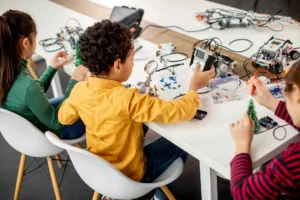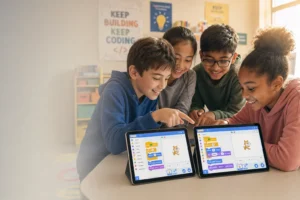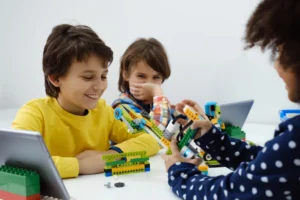

Here is what most technology program descriptions leave out: what actually happens in a session. Not the names of the platforms. Not the list of skills covered. What a student actually does from the moment they sit down until the moment they leave — what they encounter, what they struggle with, what they build, and what they walk out carrying that they did not walk in with.
At Love to Code Academy, the answer to that question is specific. Not vague promises about STEM exposure. Real work on real platforms with real character expectations attached to every session. Here is what that actually looks like from the inside.
The platforms are real, the challenges are meaningful, and the coaching is intentional — every tool and every session at LTCA is designed to build character alongside skill.
Scratch — How Block-Based Coding Builds Logical Thinking and Creative Confidence
Most people look at Scratch and see a simplified coding environment. That is a surface-level read. Scratch is where students learn the most important thing that programming requires: precise thinking. You cannot tell a computer approximately what to do. Every sequence has to be exactly right, in exactly the right order, with exactly the right logic. Scratch makes that discipline accessible to a beginner without removing the requirement for it.
What I watch for in Scratch sessions is not whether students build something technically correct on the first try. I watch for what they do when the sequence runs wrong. The student who reads the output carefully, thinks about what the code actually says versus what they meant it to say, and makes a specific correction is thinking like a programmer. That thinking — precise, sequential, willing to be wrong and then more careful — transfers to everything. It is not a Scratch skill. It is a thinking skill.
For beginners in the coding program at LTCA, Scratch is the first environment where creative confidence and logical precision develop together. A student designs what they want to build, discovers that the computer requires them to specify exactly how, and works through the gap between intention and outcome. That gap is the curriculum.
Kodable — How Game-Based Learning Develops Problem-Solving Sequencing in K-2
The K-2 students I have taught learn best when they do not know they are learning. Kodable works because the game and the coding problem are the same thing. There is no transition between “now we are playing” and “now we are learning.” The challenge is the play.
What Kodable develops in early learners is sequencing — the ability to think in ordered steps toward a goal. For a five-year-old, this is not abstract. The character in the game has to navigate to a specific point. You have to tell it how. Every command is a step in a sequence. If the order is wrong, the character goes somewhere else. The feedback is immediate and visual, which makes it possible for a first-grader to debug their own code without any technical vocabulary at all.
The character traits that develop most visibly in Kodable sessions are patience and willingness to try again. Students who discover that changing one step changes the outcome are developing an analytical habit — and they are discovering it on their own terms, in a game environment, before they have any reason to be afraid of getting it wrong.
Minecraft Education — How Collaborative World-Building Develops Teamwork and Spatial Reasoning
Minecraft Education turns a familiar student environment into a structured learning challenge. Students are not just playing Minecraft. They are completing specific design briefs, working within constraints, collaborating on shared builds, and documenting what they made and why they made it that way.
The teamwork that develops in Minecraft Education sessions is the most observable of any platform we use. When two students are building different parts of the same structure, they have to communicate about dimensions, materials, and design intent. If they do not, the two halves do not fit together. There is no workaround. The environment requires coordination, and students figure out quickly that coordination requires genuine communication — not just talking, but actually exchanging specific information and listening to the response.
Spatial reasoning develops as a byproduct of building in three dimensions under constraints. Students who regularly use Minecraft Education show improved ability to visualize how parts relate to a whole — a skill that transfers directly to engineering, design, and any discipline that requires thinking in systems.
Microsoft MakeCode — How Physical Computing Connects Coding to Real-World Outcomes
MakeCode is where coding stops being abstract. Students write code that runs on a physical device — typically a micro:bit — and produces a real-world output: a light pattern, a sensor response, a sound. The moment a student sees their code produce a physical result for the first time is one of the most reliably motivating moments in any technology program. The gap between “code on screen” and “thing that happens in the world” closes, and coding stops feeling like a skill and starts feeling like a superpower.
The character development in MakeCode sessions is concentrated around precision and ownership. Students who write code for a physical device quickly learn that imprecision has visible, immediate consequences. A sensor that triggers when it should not, a display that shows the wrong pattern — these are not abstract bugs in a simulation. They are observable failures in a physical object that the student made. Taking ownership of those failures and working through them systematically is the character work in every MakeCode session.
LEGO Education — How Hands-On Building Develops Engineering Mindset and Persistence
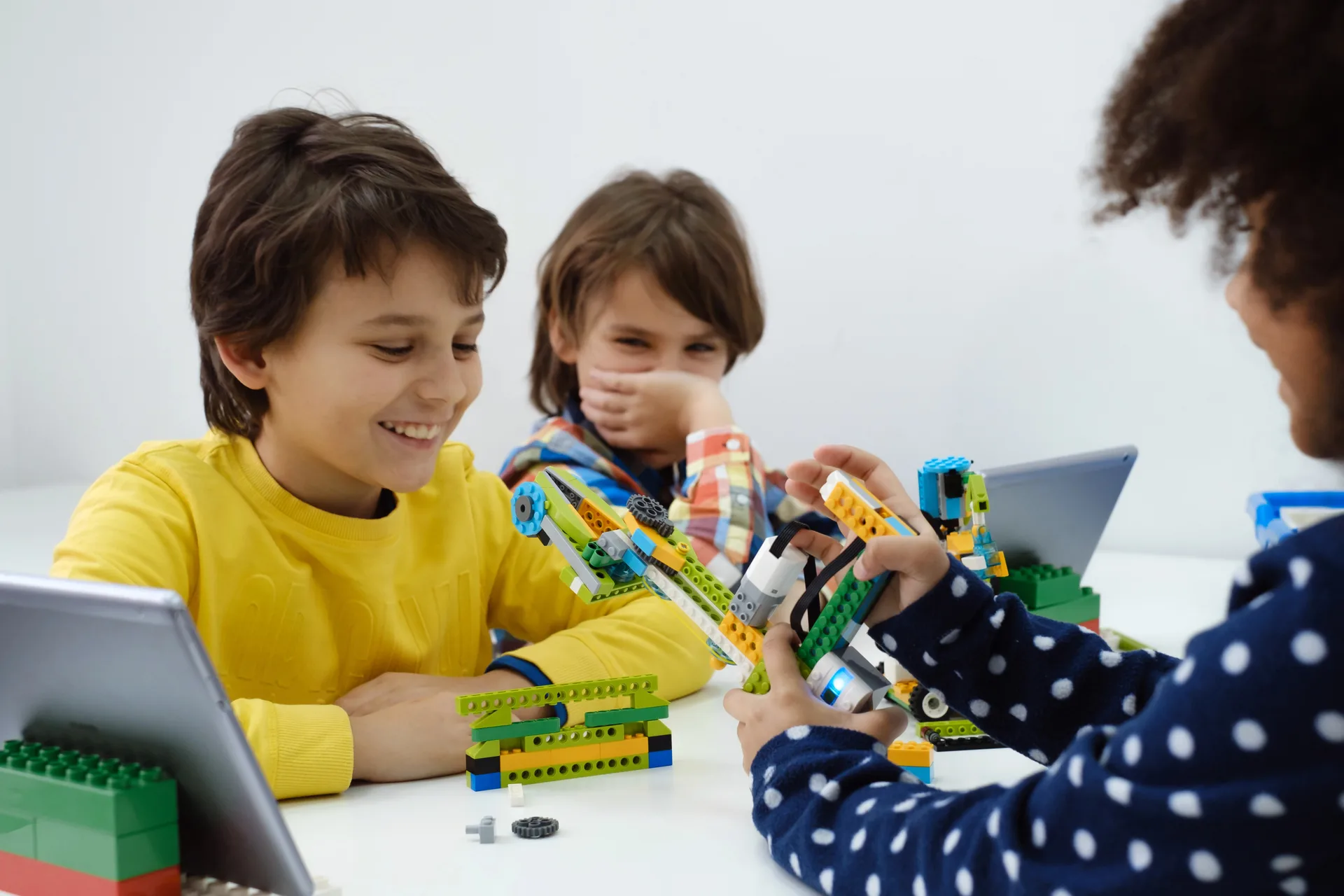
Before a student touches a LEGO Education build at LTCA, I ask them three questions. What are you trying to make? What do you think will go wrong? What will you do when it does? Most students skip the second and third questions the first time. They have not yet learned that anticipating failure is a design skill, not pessimism. By the third build, they stop skipping them — not because I insisted, but because they have already seen what happens when they do not plan for what goes wrong.
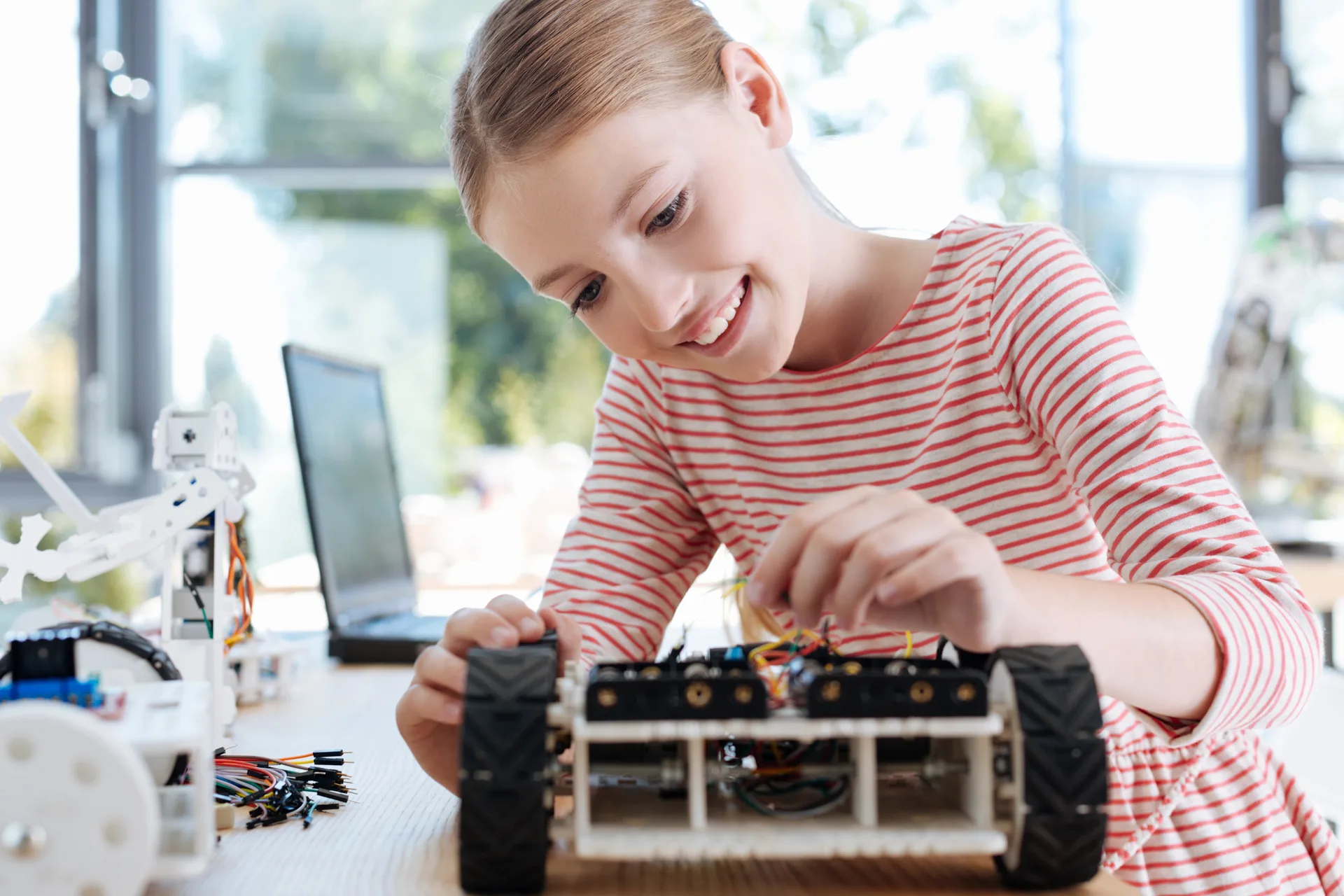
LEGO Education develops engineering mindset through the experience of iterative building. Students assemble, test, observe what does not work, and rebuild with a specific change. That cycle — build, test, learn, rebuild — is the core of engineering process, and students internalize it not as a lesson but as the natural consequence of doing the work. The persistence required to complete that cycle without giving up after the first failed test is one of the most durable character outcomes of any LTCA platform.
VEX Robotics — How Competition-Ready Robotics Develops Leadership, Precision, and Team Accountability
VEX Robotics is where everything the other platforms build toward gets tested under pressure. A VEX competition is not a demonstration. It is a real competitive event with real stakes, real opponents, and a real outcome. Students who have spent months developing persistence, teamwork, and precision in lower-stakes environments find out whether those traits hold when the stakes are actual.
What I have observed across multiple VEX build seasons is that the teams that perform best are not always the ones with the most technically sophisticated robots. They are the teams that communicate clearly under pressure, that can identify a design flaw in a warm-up run and make a targeted adjustment in the time available, and that manage disappointment — a robot that underperforms, an alliance partner who makes a mistake — without losing composure or accountability.
At LTCA, the robotics program treats VEX as the culmination of a development arc, not the starting point. Students who arrive at competition-level work have already built the character traits that competition requires. Families from Smithville, MO drive to our Kansas City location because they want their child in an environment serious enough to develop the whole student — and VEX is where that development is most visible under pressure.
How LTCA Coaches Tie Every Platform Session to a Specific Character Trait
The platform is never the point. The character is the point. Every session at LTCA — whether it is a Scratch beginner working through their first animation or a Red Belt student guiding a younger teammate through a MakeCode challenge — is an opportunity to develop and name a specific character trait.
LTCA coaches are trained to observe behavior, name the specific trait they observe, and reinforce it in real time. Not “good job.” Not a general “I like the teamwork today.” Instead: “You debugged that for eight minutes without asking for help. That is persistence.” Or: “You explained your approach to your teammate before you started. That is integrity — you told the truth about where you were in the project.” The specificity is not incidental. It is the mechanism. Students who hear their behavior named by its character trait internalize that trait faster and more durably than students who receive general praise.
Every platform at LTCA develops a specific set of traits — from passion and commitment in early coding sessions to influence and mentorship at the Lab Tech level. If you want to see this from the inside, schedule a visit or reach out with a question. We are here to show you exactly what happens in a session — not describe it from the outside.