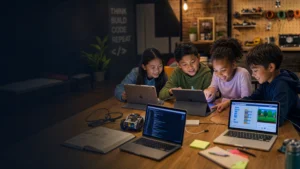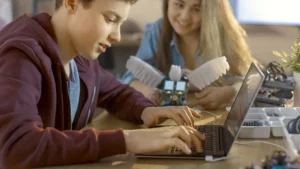
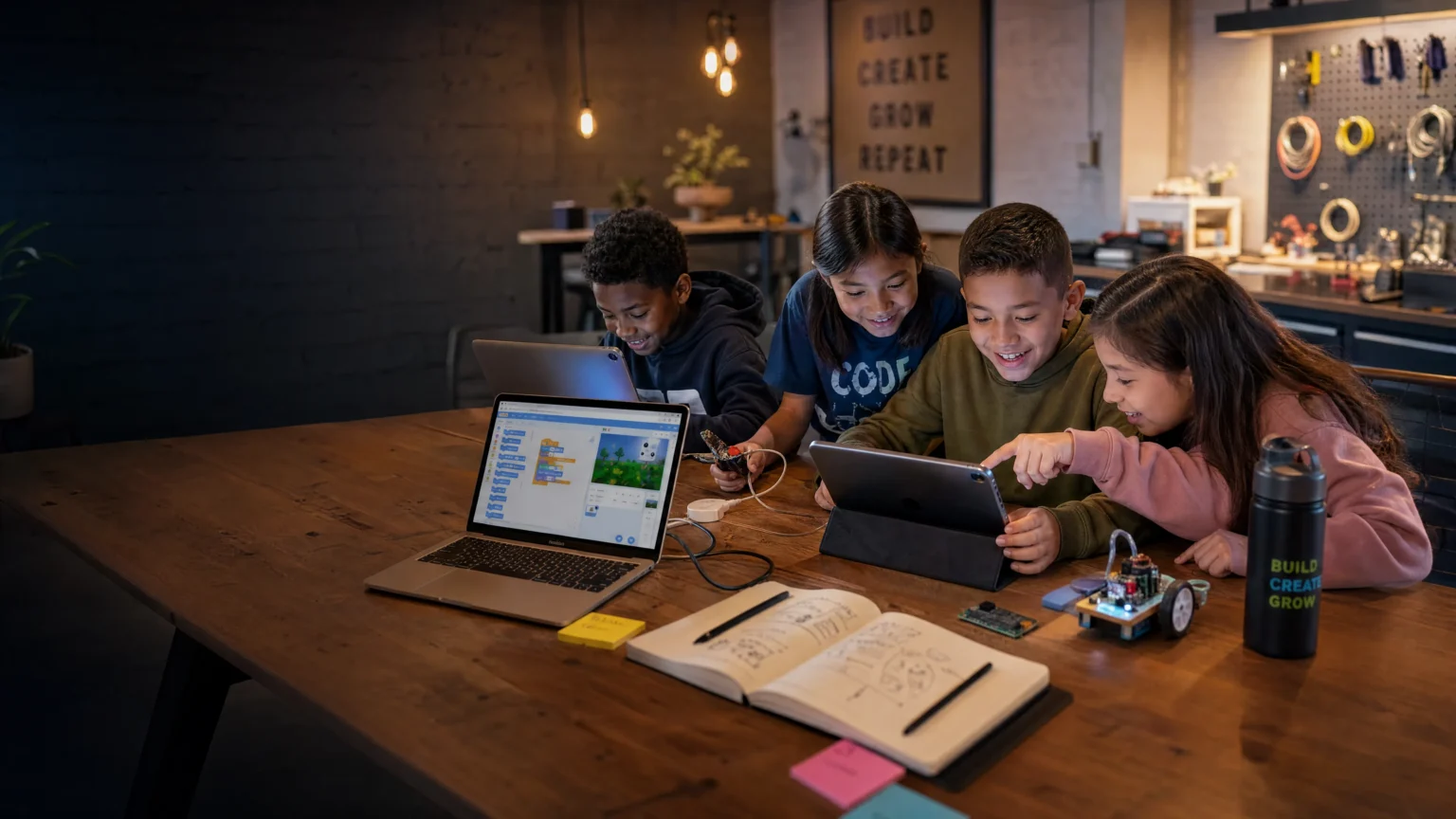
He had been working on the same bug for eleven minutes when I looked up. Not asking for help. Not frustrated in a way that was going to end in the screen closing. Just working. Trying one thing. Looking at the result. Adjusting. Trying something else.
Eleven minutes is not a long time for an adult. For a nine-year-old who, three months earlier, would have raised his hand inside sixty seconds, it is a different kind of time. Something had changed in how he understood what he was supposed to do when a problem did not immediately yield.
Persistence is the character trait that technology programs build most reliably. The reason is structural, not accidental. And the structure is specific enough that it produces a kind of persistence that transfers more broadly than what most other activities develop.
Why Most Youth Environments Do Not Build This Specific Kind
Persistence requires one condition: a difficulty that does not resolve immediately, followed by the opportunity to try again. Most environments children spend time in do not provide this reliably. School assignments have deadlines that require moving on. Sports practice moves to the next drill. Social situations have social consequences for persisting awkwardly.
A coding environment is unusual because it is designed specifically to present problems that do not resolve immediately, and to make the try-again cycle available without limit. The error message arrives. The student reads it. They adjust. They run the code again. The loop is infinitely repeatable, and the cost of each failed attempt is nothing more than the time it took.
That structure, try and fail and try again with no social penalty and instant feedback, is what makes coding one of the most effective persistence-building environments available to a child.
What the Build Looks Like Across Sessions
In the first session, most students have a tolerance for difficulty that is somewhere between twenty seconds and two minutes. That is not a character flaw. It is accurate. Children have learned, correctly, that asking for help is usually faster and easier than staying with a problem alone.
What a well-designed technology program does is make staying with a problem the obvious first response. Coaches use “what have you tried?” as a structural intervention. Before any guidance is offered, the student has to account for their own attempts. That question, repeated across weeks, builds the habit of attempting before asking.

By the third month, the students who were raising their hands inside thirty seconds are sitting with problems for five to ten minutes. Not because they were told to be more persistent. Because the environment made trying again easier than it was before, and the results of trying again started accumulating into evidence that the problems were solvable.
How This Differs From Persistence in Sports or Music
Persistence exists in other youth activities. A student who practices an instrument builds it. A student who trains for a sport builds it. But the mechanism is different, and the transfer works differently.
In music, persistence is built through repetition of a known skill. The student plays the passage again and again until it is right. The problem is always the same problem. In sports, persistence is built through physical effort sustained over time.
In a coding or robotics environment, persistence is built through iterative problem-solving: the challenge is different each time the student adjusts their approach, and what is being practiced is not the solution but the method of finding one. That is closer to the kind of persistence that applies to academic work, professional challenges, and any situation where the answer is not known in advance.
A student who has built persistence through coding has practiced staying with an unknown problem. That transfers to every domain where the problem has no obvious answer.
What Parents at LTCA Observe at Home (Sandra)
The pattern that parents describe after the first year of enrollment is consistent across families and across age groups. The behavior changes appear first in contexts that are structurally similar to the coding environment: homework, building projects, games with unclear rules. Then they begin appearing in social and emotional situations as well.
Parents describe children who no longer abandon difficult homework problems inside the first minute. Children who rebuild something that broke rather than asking for a replacement. Children who, when a plan does not work, make a new plan rather than asking someone else to solve it.
Those are persistence signals, and they are not coincidental. They are the direct output of a program designed to produce exactly this: a child whose default response to difficulty is to try something, rather than to stop.
How the Belt System Reinforces What Each Session Builds
One of the structural features that makes the persistence developed in a coding environment more durable than persistence developed in less structured activities is the presence of a visible, external progression framework.
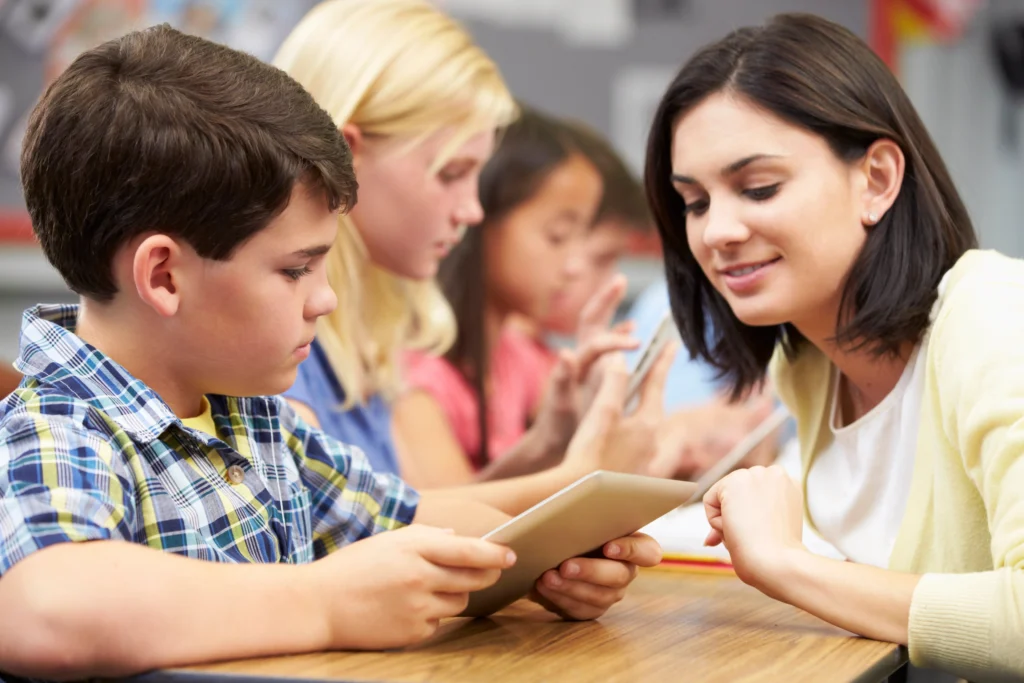
A student who has been working at yellow belt for several months and advances to orange belt has not just cleared a technical threshold. They have demonstrated, to an external evaluator and to themselves, that they can approach genuinely hard challenges with the patience and focus the next level requires. That is not a grade on a single assignment. It is a recognized pattern of behavior across a period of time.
The belt system makes the try-again habit visible and valued in a way that reinforces it. A student who knows that persistence is being observed and recognized at every belt level has a structural reason to keep exercising it. The environment is not neutral on the subject. It rewards the behavior explicitly. That reward signal, repeated across dozens of sessions and several belt levels, is part of what makes the persistence habit stick in a way that feels intrinsic rather than externally motivated by the time a student reaches the middle belt levels.
What the Twelve-Month Student Looks Like
The change in a student after a full year in a well-structured technology program is visible to anyone who knew them at the start, but it is not always visible to the student themselves. It has happened gradually enough that they do not experience it as a transformation. They experience it as just how they are now.
From the outside, the twelve-month student has a different tempo with difficulty. They slow down in front of a hard problem rather than speeding up to escape it. They make a first attempt before asking for help as a matter of habit rather than as a deliberate choice. They describe their own problem-solving process in specific terms. “I tried the loop first, that didn’t work, so I changed the condition” is a narration that did not exist at month one.
Parents who have been watching for a full year describe a quality that the twelve-month student carries into non-program environments: they approach new challenges as figurable-out rather than as fixed obstacles. That is the persistence signal that has fully transferred. It is not specific to coding. It is a general orientation toward difficulty that the coding environment built over many sessions and is now operating independently of the program.
For Riverside Families Interested in This Outcome
Families from Riverside who are looking at kids programs in the Kansas City area and asking what will actually change in their child are asking the right question. The answer that matters most, the one that shows up outside the program, is persistence.
Love to Code Academy is at 248 NE Barry Road, about twelve minutes from Riverside. The after-school program is built around the structural conditions that make persistence develop: short feedback loops, a coaching culture that asks “what have you tried?” before offering answers, and a belt progression that rewards the try-again habit alongside technical skill.