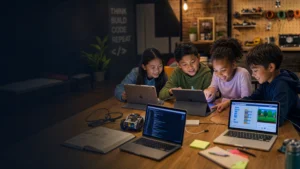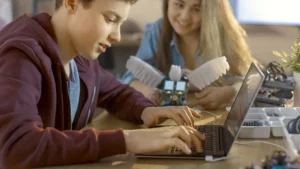

The first day Marcus walked into a session, he stood at the door for four full minutes before he came in. His mom was behind him with one hand on his shoulder. He was seven. He had no idea what coding was. He was certain he could not do it.
By the end of that semester, Marcus was the first student to sit down when the session started. He set up his station while other kids were still taking off their backpacks. That is not a story about a child who learned to code. That is a story about a child who found out he belongs somewhere.
The most important things that happen at a character-based technology program are not the projects students build — they are the moments students discover they can do hard things.
What Developmental Growth Looks Like at Different Ages
Growth does not look the same at every age, and a well-designed technology program accounts for that. A kindergartner and a fourth grader are not building the same things, developing the same character traits at the same pace, or responding to challenge in the same way. Understanding what growth actually looks like at each stage helps parents know what to watch for.
In grades K through 2, growth looks like belonging. The five and six-year-olds who come into a technology session for the first time are not thinking about coding. They are thinking about whether this is a safe place to try something and get it wrong. The character trait that grows most visibly in this stage is something quiet: willingness. Willingness to sit next to someone new. Willingness to try again when the first attempt does not work. Willingness to raise a hand. That is real growth, even when it looks small from the outside.
In grades 3 through 5, growth starts to involve ownership. Students in this stage move from participating in something someone else designed to taking real responsibility for their part of it. A student who brings a problem to the instructor every five minutes in October and is working independently through similar problems in February has grown in ways that a project alone cannot show. The shift from “fix it for me” to “let me try first” is one of the most visible character milestones in this age group.
In grades 6 through 8, growth looks like leadership emerging. These students have enough skill and enough confidence to start noticing the students who do not. The ones who begin helping younger students through problems without being asked — not doing it for them, but guiding them — are practicing mentorship in real time. That is not a program outcome we can manufacture. It is what happens when the earlier growth is real.

The Moment Kids Shift From “I Can’t” to “Let Me Try Again”
There is a moment in almost every student’s journey that I think about more than anything else that happens in a session. It is not the finished project. It is the moment a child stops saying “I can’t do this” and says “let me try again” instead.
It does not happen on a schedule. For some kids it happens in the third session. For others it takes two months. What causes it is consistent: a challenge they could not solve on the first try, an instructor who held back instead of solving it for them, and enough safety in the room to keep going anyway.
The after-school coding program for kids at LTCA is structured around this moment. The challenges are real. The instructors are trained not to rescue students from productive struggle. The environment is safe enough that making a mistake in front of other people does not feel like failure — it feels like the beginning of the next attempt. That combination is not accidental. It is designed.
How Structured Technology Challenges Develop Persistence Differently
Persistence is built in the space between a problem and giving up. The question is whether the environment is designed to create and protect that space — or whether it closes the space too quickly by stepping in, simplifying, or removing the difficulty.
What makes technology challenges uniquely good for building persistence is that the feedback is immediate, specific, and honest. A robot that does not turn correctly tells the student exactly that it did not turn correctly. The code that runs an unintended loop shows the student exactly what it is doing. There is no ambiguity, no social judgment, no subjectivity. The environment gives feedback and waits. What happens next is the character work.
Students in the robotics program at LTCA encounter this feedback loop in every session. A robot that falls off the course during a test run is not a failure. It is a data point. Students who learn to read it as a data point instead of a verdict about their ability are building something more durable than a robot. They are building the habit of persistence.
What Social and Emotional Growth Looks Like Inside a Technology Environment
I notice social growth the way you notice weather changing. Gradually and then unmistakably.
A student who sat alone at their station for the first six weeks and is now the one who says “come look at what I built” has crossed something. I do not always know exactly when it happened. But I can tell you what it looked like when it did: they stopped protecting themselves from the possibility of being wrong in front of someone else. That is not a small thing. For a lot of kids, that is the hardest thing in the room.

Technology environments create unusual opportunities for social growth because the collaboration is real. In a coding session, if you do not share what you figured out with your teammate, the project stalls. There is a genuine reason to communicate. There is a genuine cost to not communicating. Students learn teamwork not because they are told to, but because the environment makes it necessary and the instructor names it when it happens.
How Growth Becomes Visible — What Parents Notice First at Home
The parents who call me most often are not calling to report problems. They are calling to describe something they noticed at home that they do not have words for yet. A child who used to give up on homework after five minutes and is now staying in it for twenty. A child who helped their younger sibling through something frustrating instead of losing patience. A child who managed a difficult loss — in a game, in a competition, in a conversation — with a composure they did not have before.
These parents are describing what a character-based coding program actually produces. Not the code. The character. And they almost always say the same thing: “I do not know when exactly it happened. I just noticed they were different.”
Families from Gladstone, MO and across the northland bring their children to LTCA because they want this kind of growth. The kind that shows up at dinner, at school, and on a hard day. Not just at the keyboard.
The Student Arc From First-Time Beginner to Peer Mentor and Lab Tech Leader
What I have watched over three decades of working with youth development programs is this: the programs that produce real leaders do not set out to produce leaders. They set out to develop every student fully at every stage — and leadership is what happens when that development is genuine.
At Love to Code Academy, the belt system maps this arc explicitly. White belt students are learning to belong. Yellow belt students are practicing and discovering what persistence feels like. Orange and Green belt students are taking ownership — of their work, of their mistakes, of their role on a team. Blue and Purple belt students are creating original things and iterating on them because they want to make them better. Brown, Red, and Black belt students have earned the right to lead others — not because they are the oldest or the most technically skilled, but because they have demonstrated the character traits that make leadership real.
The Lab Tech pathway formalizes this. Advanced students assist instructors, mentor younger students through their own belt journey, and help peers troubleshoot projects. They are not doing the work for their mentees. They are developing them. That distinction is the whole point — and it is the arc every student who starts at white belt is walking toward.
The arc from white belt to Lab Tech is the arc from learning persistence to practicing mentorship. If you want to see what this looks like from the inside, explore our programs or get started with enrollment.