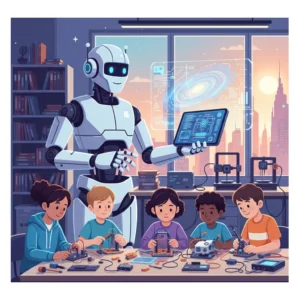

Most parents searching for coding classes for kids near me are not short on options. What they are short on is a framework for evaluating them. Every program has a website. Every program has testimonials. Every program uses words like “engaging,” “confidence-building,” and “future-ready.” After thirty years of watching parents navigate this decision, I have learned that the parents who get it right are the ones who ignore most of what programs say about themselves and instead ask a few very specific questions.
This guide is those questions — and what honest answers actually look like.
The best technology program for your child is not the one with the most tools or the longest curriculum. It is the one with a clear answer to the question: what kind of person will my child become here?
The Three Questions Every Parent Should Answer First
Before you evaluate any program, answer three questions about your child. The answers will eliminate most options before you read a single description.
First: what does your child need most right now — structure, creativity, or collaboration? Some children thrive in clearly defined progression systems where they always know exactly what the next goal is. Others need open-ended creative environments where they direct their own work. Others need team environments where the social dimension is as much of the draw as the technical work. Coding, robotics, and esports are all technology environments, but they develop different things with different emphases. Your child’s answer to this question points toward a track.
Second: what are you hoping changes? Not “what skill do you want them to gain” — what do you want to be different about your child six months from now? A parent who wants their child to develop persistence and the ability to work through difficulty is looking for a different program than a parent who wants their child to find a creative outlet. Both are legitimate. They lead to different programs.
Third: how much time and consistency can your family commit to? An after-school program that runs weekly requires real scheduling commitment. A one-week summer camp does not. The best program in the world is not the best program for your family if attendance is irregular. Character development requires consistency. Programs that produce lasting growth are ones children attend reliably, not occasionally.
Coding vs. Robotics vs. Esports — Understanding Which Fits Your Child
These three tracks are not interchangeable. Each one develops different primary skills and different primary character traits, though all three draw from the same character framework at LTCA.
Coding is the most independent of the three. Students spend significant time working alone on their own projects, debugging their own code, and managing their own creative decisions. It is the best environment for developing persistence and creative ownership. Children who are imaginative, self-directed, or who connect deeply with the idea of building something that did not exist before will often thrive here.

Robotics is the most collaborative. It genuinely requires a team to succeed — not in the loose sense that many youth activities use that word, but in the specific sense that one person cannot do all the roles required to build, program, and compete with a robot. It is the best environment for developing teamwork, communication, and the specific kind of trust that comes from depending on someone to do their job correctly. Children who are social, who like building physical things, or who are energized by group problem-solving tend to find their place in robotics quickly.
Esports is the most competitive. It develops self-control, strategic thinking, and sportsmanship — all under genuine competitive pressure that other programs simulate but esports actually creates. It is especially good for children who are already drawn to gaming and need an environment that redirects that energy toward personal growth rather than just screen time.
The coding, robotics, and esports programs at Love to Code Academy each run on the same character framework — the technology is the environment, the character is the goal — but they are genuinely different experiences. Choosing the right one matters.
After-School Programs vs. Camps — Different Formats, Different Purposes
This is a distinction that simplifies a lot of enrollment decisions. After-school programs and camps are not the same thing delivered in different amounts of time. They serve different purposes and produce different kinds of outcomes.
An after-school program is a character development environment. It produces lasting growth through consistency over months. Students develop relationships with their instructors and teammates. They hit walls, work through them, and carry the experience of having done so into the next session. The belt progression at LTCA is built for after-school programs — it requires the consistency of weekly sessions to develop the demonstrated character that belt advancement requires.
A camp is a discovery environment. It produces real experience in a compressed time frame and is the best way for a student who has never tried a technology program to find out whether they connect with one. LTCA’s summer camps are full experiences, not introductory samples — but they are designed to give your child a genuine first look at what a technology program involves. Many of the students who go on to become long-term LTCA members started with a camp.
If your child has never tried a technology program, start with a camp. If your child has already discovered what they connect with, an after-school program is where real development happens.
What a Strong Instructor Looks Like Beyond Technical Knowledge
The instructor is the program. Every other variable — the platform, the curriculum, the equipment — is secondary to the person standing in the room. This is the hardest thing for parents to evaluate from a website, but it is the most important one to get right.
A strong technology instructor knows their platform well. That is necessary but not sufficient. What makes an instructor excellent in a youth technology program is the ability to observe character, name it specifically in the moment, and develop it through the way they structure challenge. The instructor who says “good job” when a student finishes a project is less valuable than the instructor who says “you stayed with that for twenty minutes without asking for help — that is persistence” and means it every time.

Ask this question directly when you visit or contact a program: how do your instructors develop character specifically? Not “do they care about character development” — how do they do it? What does an instructor say when a student demonstrates persistence or integrity in a session? If the answer is vague or if the program cannot give you a specific example, the character development is not structural. It is decorative.
How to Evaluate a Program’s Track Record With Kids Like Yours
Evaluating a program’s actual results requires looking past the testimonials on the homepage. Here is a more reliable process.
First, ask about retention. What percentage of students re-enroll semester to semester? Programs that produce real growth keep students. Programs that do not produce growth lose them. A high re-enrollment rate is not proof of quality on its own, but a low one is almost always a signal worth investigating.
Second, ask what specific changes parents report after the first semester. Not “are parents satisfied” — what specifically are they saying? Programs confident in their results can describe patterns. At LTCA, the pattern is consistent: parents describe their children as more patient, more willing to stay in a difficult problem, and more likely to try again after failing. That specificity is the track record.
Third, ask how the program handles a student who is struggling — not technically, but behaviorally. A student who is having a hard time managing frustration in a session is an opportunity for character coaching. Ask the program what that coaching looks like. The answer tells you whether character development is a marketing position or a teaching practice.
Families from Parkville, MO and the Kansas City northland find the answers at Love to Code Academy specific and consistent. We welcome that scrutiny.
What to Expect in the First Session and First Month
The first session should feel like an orientation, not a performance. Students are new to the environment, new to the people, and new to the expectations. A first session that pushes immediately on technical difficulty before students feel comfortable is a program that has confused speed with rigor. The two are not the same.
Expect the first session to involve the instructor establishing expectations clearly — not as a rules lecture, but as a demonstration of what the environment is and what it requires from everyone in it. Expect students to work on something achievable to build early confidence, not something ambitious that highlights what they do not yet know. Expect the instructor to name character traits they observe in real time during that first session — so students understand immediately that the program is about more than the technical work.
In the first month, the growth signal to watch for is comfort, not accomplishment. Is your child willing to come back? Are they talking about what they made? Are they becoming less afraid to try something they might get wrong? That is the first month working. Programs that develop real integrity and persistence are rare — and when you find one, the growth shows up at home, not just in the classroom. Get started here or ask us a question first — we will help you find the right fit.