The children who thrive most quickly inside a technology program were identifiable before they ever enrolled. Not by their report cards, not by how much time they spent on a screen at home, not by any conventional readiness metric.
They were identifiable by certain observable behaviors: patterns that parents often overlook because they do not look like STEM readiness. They look, instead, like personality. Like the way a kid already is.
Here are the signs that a child is ready for an after-school STEM program, signs that tend to appear well before the parent has thought to look for them.
Sign 1: They Want to Know How Things Work
The child who takes apart the remote control to see what is inside. The child who asks why the screen goes dark after thirty seconds. The child who builds structures out of whatever is available and then immediately wants to know how to make them more stable.
Curiosity about mechanism, about the why underneath the what, is the most reliable early signal. It is not about technology specifically. It is about a fundamental orientation toward the world that asks how rather than just accepting what. That orientation is what a STEM environment rewards and develops, and it is one of the clearest signs a child is ready for one.
Sign 2: They Enjoy Building Things With Their Hands
A child who gravitates toward building, blocks, LEGO, household objects reconfigured into something new, is already practicing the engineering mindset at the core of both robotics and coding. They are learning to translate an idea in their head into a physical outcome through deliberate action. That translation, idea to action to result, is the same process coding and robotics ask students to practice, just in a more structured environment.
This sign often goes unnoticed because it looks like play rather than preparation. It is both. A child who spends an hour engineering a structure out of couch cushions is doing exactly the kind of thinking that a robotics program for kids is designed to develop further.
Sign 3: They Experience Failure Differently Than Most Kids
Not comfortably. Very few children are comfortable with failure at the start. But differently. The child who, after a moment of frustration, resets and tries again without being asked. The child who, when something breaks, immediately starts thinking about how to fix it rather than abandoning the project.
This is the early signal for persistence, and persistence is the quality LTCA develops more deliberately than almost any other. A child who shows even the earliest version of this pattern will respond to a structured technology program in ways that accelerate quickly. The program meets that instinct and builds a structure around it.
Sign 4: They Are Genuinely Interested in How Digital Things Work
A child who asks why an app does what it does. A child who notices when a game behaves unexpectedly and wants to understand why. A child who has ever asked “who made this?” about something they encountered on a screen.
This is digital curiosity, an early version of the passion that drives the best student outcomes at LTCA. It does not require that the child already understand programming. It requires only that they find the question interesting. That curiosity is what a coding program gives somewhere to go.
Sign 5: They Can Work Alongside Other Kids
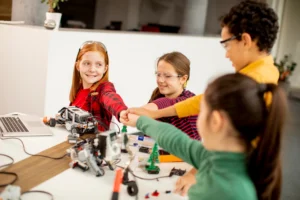
STEM programs at LTCA are not solo experiences. Coding projects are shared. Robotics builds are collaborative. Esports competition is a team environment. A child who has some capacity to work alongside peers, to share tools, to accept input, to contribute to a group result, will be more immediately at home in the program than one who has not developed that capacity yet.
This does not mean a child needs to be a social butterfly. Some of the strongest LTCA students are introverted kids who find the structure of a technology-focused group more comfortable than unstructured social environments. What it means is that a child who can share a workspace and take a turn has enough social foundation to begin.
What the First Session Looks Like (Avery)
The children who carry these signs walk into the first session carrying them without knowing it.
They come in looking at everything. Not the instructor. The room. The screens, the robots on the shelves, the build materials on the table. That is the curiosity signal, visible in the first thirty seconds.
The children who have some comfort with difficulty are the ones who, when they hit their first problem, pause before they raise their hand. Just a moment. They try something first. Then they ask. I noticed one student last semester do exactly that, three sessions in a row, each time the pause getting a little longer. That small moment of independent attempt, quiet, often invisible to other kids in the room, tells me more about where a student will be in six months than almost anything else I observe.
A child who arrives with enough harmony to settle into a new environment without needing to control it, who finds a project and starts, and who stays in the moment when something unexpected happens: that child is ready. The five signs described above are how to recognize them before they ever walk through the door.
What the Program Does With These Signs Once the Student Enrolls
The five signs described in this post are entry points. The program takes each one and builds on it deliberately. A child who arrives with curiosity about how things work encounters a structured environment that gives that curiosity somewhere to go: real problems, real tools, real feedback, and a coach who asks the questions that develop the thinking habit into a reliable skill.
A child who shows early persistence gets placed in situations designed to test and extend it, not to overwhelm it. The challenge level at white belt is calibrated to produce a high success rate with meaningful effort required. The student who arrives ready to try something hard finds something appropriately hard to try. That calibration is what makes the first experience generative rather than discouraging.
The signs in this post describe a child who is ready to receive what the program offers. The program is designed to meet that child where they are and move them forward from there. If you recognize your child in what you have read, the step worth taking is simply starting.
For Kansas City Area Families Watching for These Signs
If you are reading this and recognizing your child in these descriptions, the practical next step is simple. Kansas City northland families from Parkville, Liberty, Gladstone, Riverside, and Smithville all have access to Love to Code Academy at 248 NE Barry Road.
The signs described in this post are starting points, not finish lines. The coding and robotics programs at LTCA begin at the white belt level. Every student starts where they are, and the program builds from there. The five signs above describe a child who will thrive. They do not describe a child who already has everything they need. The program provides what they need. The signs just tell you the student is ready to receive it.
The after-school STEM program at LTCA serves students in grades K through 8. If you recognize your child in what you have read here, that recognition is worth acting on.