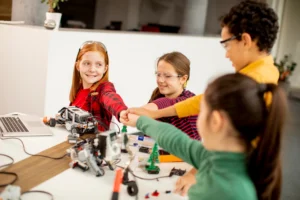

The question of what age kids should start coding arrives constantly, and it almost always comes with the same underlying anxiety: am I waiting too long? Is my eight-year-old already behind? Did I miss the window?
The starting age question matters less than parents believe, and the window is wider than most programs will tell you. What actually determines outcomes is not when a child starts. It is the quality of what they encounter when they do.
Ages 4-6: Earlier Than Most Parents Think to Ask
Children in kindergarten and early first grade are capable of engaging with foundational coding concepts when those concepts are taught through the right tools. Platforms like Kodable, which LTCA uses with its youngest students, present coding logic through visual, game-based environments that a five-year-old can navigate and genuinely enjoy.
The most important thing a K-2 coding experience does is not teach syntax. It teaches the foundational thinking pattern: if I do this, that happens. If I want that result, what do I need to do first? That cause-and-effect logic is the substrate everything else is built on. A child who develops it at five does not have to unlearn anything when they move into more complex programming at ten.
The passion that young students develop when they realize they can build something that works, even something simple, creates a motivation that carries them further than any curriculum design alone could. Starting early, when enthusiasm is unconditional, is an advantage that is difficult to recreate later.
The Cognitive Leap Around Ages 7-8
Between ages seven and eight, most children experience a meaningful shift in abstract thinking capacity. They become able to hold multiple steps of a logical sequence in mind simultaneously, to think about a process before executing it, and to evaluate a result against an intended outcome with greater precision.
This is the age at which coding starts to feel genuinely productive rather than just exploratory. A seven or eight-year-old can begin working in Scratch with real purpose: building small games, creating interactive stories, writing sequences that require them to plan ahead. The satisfaction of building something another person can actually use becomes available at this stage.
Students who started with exploratory game-based coding at five or six often hit this stage with a significant head start. They already have the cause-and-effect thinking habit. They already know what it feels like to produce a result through an instruction they wrote. When the cognitive capacity arrives for more complex work, the foundation is already there.

Grades 3-5: The Natural On-Ramp for Most Families
Students in grades three through five arrive with the cognitive capacity to handle more abstract programming concepts and the social and emotional development to work productively in structured groups. This is where platforms like Scratch become powerful and where the coding classes for elementary school kids at LTCA produce some of their most consistent growth.
Students in this range typically advance through early belt levels with strong momentum because their capacity for sequential problem-solving is well developed. The combination of technical growth and character development, the persistence to debug, the self-control to work through frustration, the teamwork to collaborate on a shared project, compounds visibly over a semester.
There is no disadvantage to starting here. Families who have a third or fourth grader asking about coding and who act on that curiosity promptly are making a well-timed decision.
Middle School: Not Too Late by Any Measure
Parents of middle schoolers sometimes arrive with the worry that they have waited too long. They have not. A sixth or seventh grader who has never written a line of code can advance through the LTCA belt system faster than a seven-year-old simply because their cognitive and emotional development gives them more tools to work with.
What middle school students bring is the capacity to engage with genuinely complex problems and feel the full satisfaction of solving them. The persistence that develops when a twelve-year-old debugs a difficult piece of code is qualitatively different from what a seven-year-old experiences: deeper, more explicitly connected to other areas of life the student cares about, and more transferable to professional skills they will eventually need.
Platforms like Microsoft MakeCode and VEX Robotics are particularly effective at this age because they connect coding to physical, tangible outcomes, a programmed device that behaves the way the student intended, which makes the abstract logic concrete in a way that satisfies the more sophisticated thinking middle schoolers bring to the work.
Why Starting Earlier Compounds Over Time
If there is an argument for starting on the earlier side of the available window, it is about compounding. The thinking habits, the confidence with difficulty, and the genuine interest in how technology works develop over time, and they develop most deeply when they begin early.
A student who starts at six and stays for four years arrives at middle school with a completely different relationship to technology than one who starts at ten. Not because the ten-year-old cannot catch up on technical skills, they can, often quickly. But because four years of building the persistence habit, the problem-decomposition habit, and the emotional resilience that comes from working through hard technical problems is not something that can be compressed into a shorter window.
What the Belt System Does Regardless of Starting Age
Every student at LTCA begins at white belt, regardless of age or prior experience. A nine-year-old and a thirteen-year-old who both start for the first time begin at the same level, but the program meets them at their actual cognitive level. The platform complexity, the challenge design, and the pace all adjust. The character development framework applies equally.
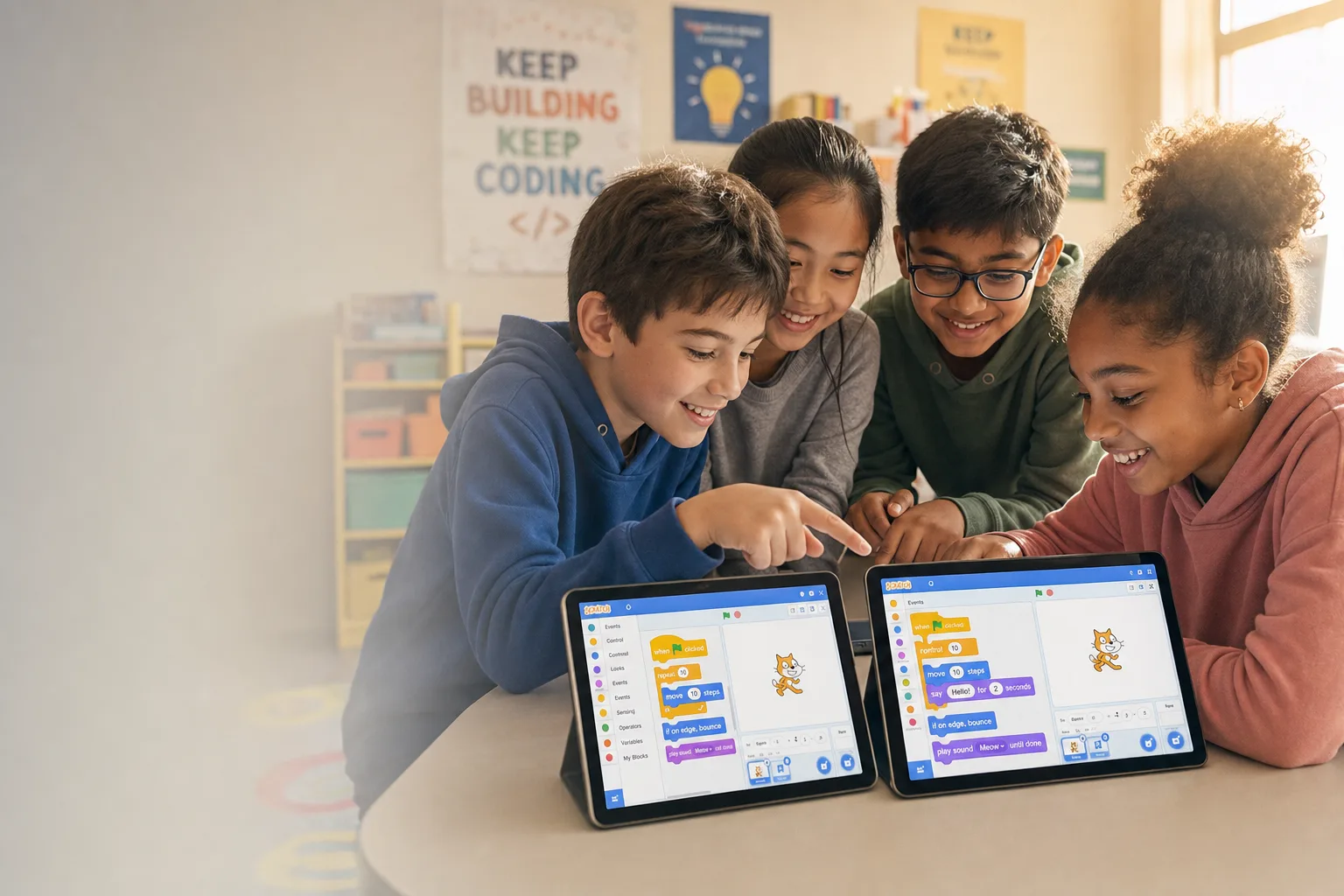
This structure removes the “am I too late” anxiety in a concrete way. The program is designed to work with a student wherever they begin, and the belt progression gives them a visible, motivating path forward from that starting point. Growth from white belt to yellow belt means the same thing whether a student achieves it at seven or at twelve: real skill and real character development, earned together.
What Parents of Early Starters Consistently Report
Families who enrolled a child at age five or six and stayed enrolled through middle school describe a particular kind of growth that families who started later do not describe in quite the same way. It is not just technical skill. It is a fundamental orientation: a child who has spent years treating hard problems as solvable, who has built their identity in part around the capacity to figure things out, approaches adolescence differently.
The confidence that comes from six years of accumulating evidence that difficult things are workable is not the same as the confidence that comes from two years of the same experience. Both are real. But the depth and the stability of the former are different in quality, not just degree.
Parents who started their children early and stayed the course almost universally say the same thing when asked about the timing decision: they are glad they did not wait. Not because the later start would have produced nothing, but because the years they did not wait produced something they cannot imagine being without.
For Parkville Families Thinking About Timing
Parents from Parkville often ask this question during initial conversations. The answer is consistent: the best time to start is when your child is interested. Not when you have engineered the perfect moment. When the curiosity is present, that is the time.
Love to Code Academy is located at 248 NE Barry Road in Kansas City, approximately ten minutes from Parkville. Parkville families who have been enrolled for a year or more describe the same pattern: the starting age matters less with every passing semester, because the growth the student experiences quickly becomes its own argument for continuing.
The after-school program at LTCA serves students in grades K through 8. If your child is anywhere in that range and the interest is present, the timing is right.