Parents who enroll their children in a coding program almost always arrive with the same question: will my child learn to code? That question is reasonable. It feels practical, measurable, and concrete.
The question that matters more is this: what kind of person will my child become in the process of learning to code? Every program that teaches coding teaches something else alongside it. The programs parents keep talking about five years later are the ones that were deliberate about what that something else was.
Here is what kids coding classes actually teach, and why parents who stay long enough almost always name something other than code when you ask them what changed.
Persistence: The Compiler Does Not Negotiate
A compiler does not grade on effort. It does not award partial credit for trying. When a child writes code and it does not run, the screen tells them exactly what is wrong and then it waits. No encouragement. No comfort. Just the problem and the student.
That is one of the most valuable environments a child can learn in. Most places children spend time are full of adults who soften the hard moments. Coding does not soften. When a child learns to read an error message, figure out what went wrong, and try again without anyone asking them to, they have learned something that follows them into every other difficult thing they will face.
Persistence developed inside a coding environment is not a metaphor. It is a practiced skill, built through repetition across dozens of sessions. The students who build it at nine or ten carry it into their schoolwork, their sports, and eventually their careers.
Teamwork: How Collaborative Coding Builds It Differently
When parents think about teamwork-building activities, most think about sports. That association is reasonable. But coding and robotics build teamwork through a different mechanism, and in some ways a more transferable one.
In team sports, roles are often sorted by physical ability. In a collaborative coding or robotics project, the child who thinks most carefully before speaking can be the most valuable person in the group. The quieter student who spots the logical error that everyone else walked past becomes indispensable in a way that does not happen on most playing fields.
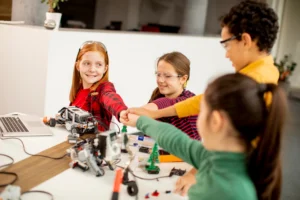
When a team of students is trying to get a robot to navigate a course and it keeps veering left, they have to talk to each other. They have to share observations, test theories, rebuild when the rebuild is needed, and trust the people working beside them. That is genuine collaboration, not arranged collaboration, but the kind that emerges because the problem actually requires it.
Logical Thinking and Problem Decomposition
Every coding project asks a child to take a large problem and break it into smaller parts. That sounds simple. It is not a skill most adults have fully developed.
A student in after-school coding classes learns quickly that you cannot solve the whole problem at once. You write one function. You test it. You fix it. You move to the next one. The structure of the work itself teaches the thinking. This decomposition skill, the ability to identify the first step inside a complex problem, transfers directly into academic work, social challenges, and anything a child encounters that feels overwhelming at first sight.
Educators describe this as computational thinking: the practice of breaking complex problems into manageable steps, recognizing patterns, abstracting away irrelevant detail, and designing a sequence of instructions that produces the desired result. It is the underlying logic behind every programming language, and it is a cognitive tool children can apply to problems that have nothing to do with a screen.
The Coding Tools That Build These Skills at Different Ages
The skills coding teaches are real at every age, but the tools that develop them effectively differ significantly between a six-year-old and a twelve-year-old.
For K-2 students, game-based platforms like Kodable introduce sequencing and cause-and-effect logic through visual puzzles that feel like play. There is no text syntax, no error message in the traditional sense, just a visual result that either matches what the student intended or does not. The thinking habit forms before the technical vocabulary does.
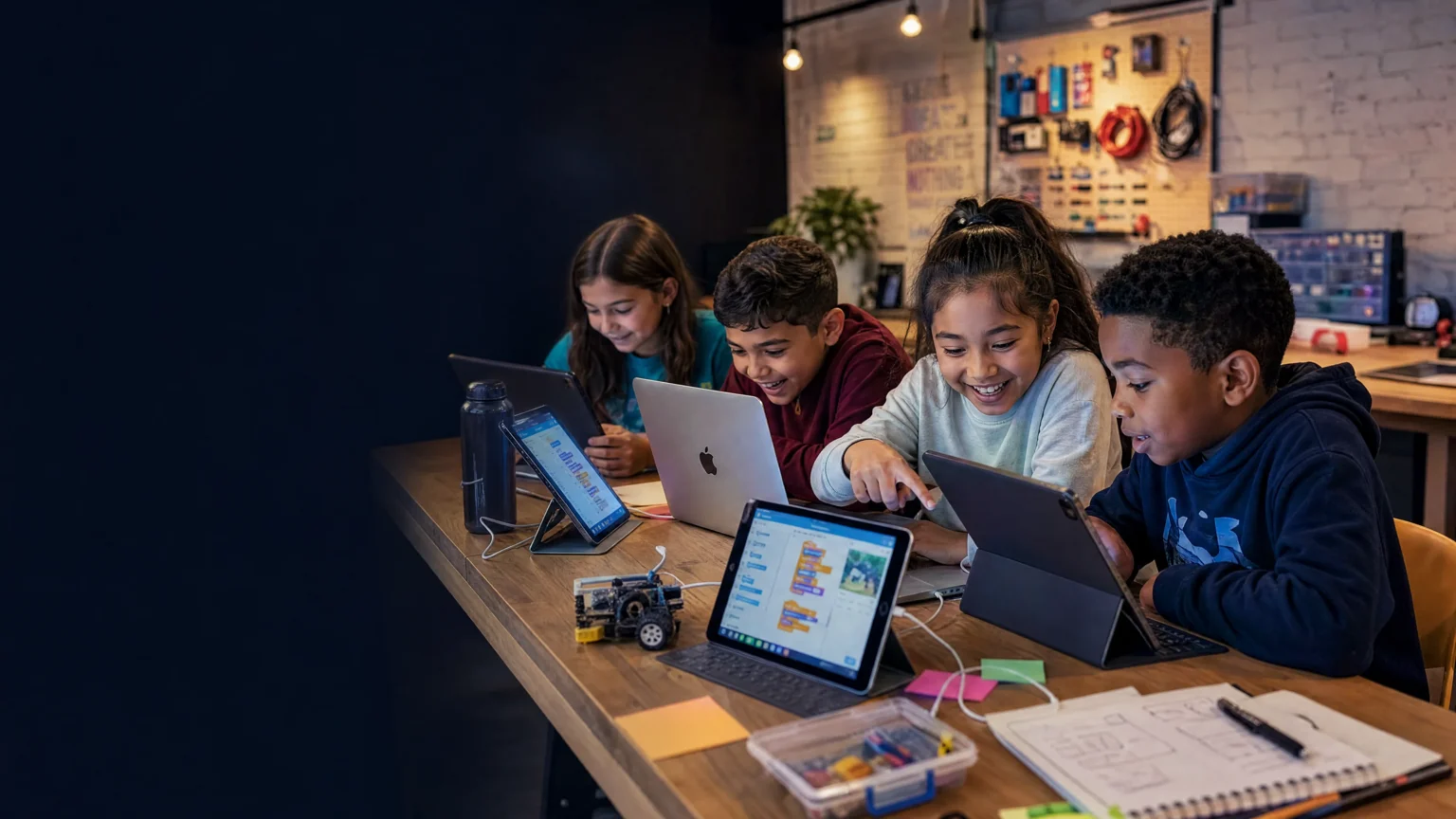
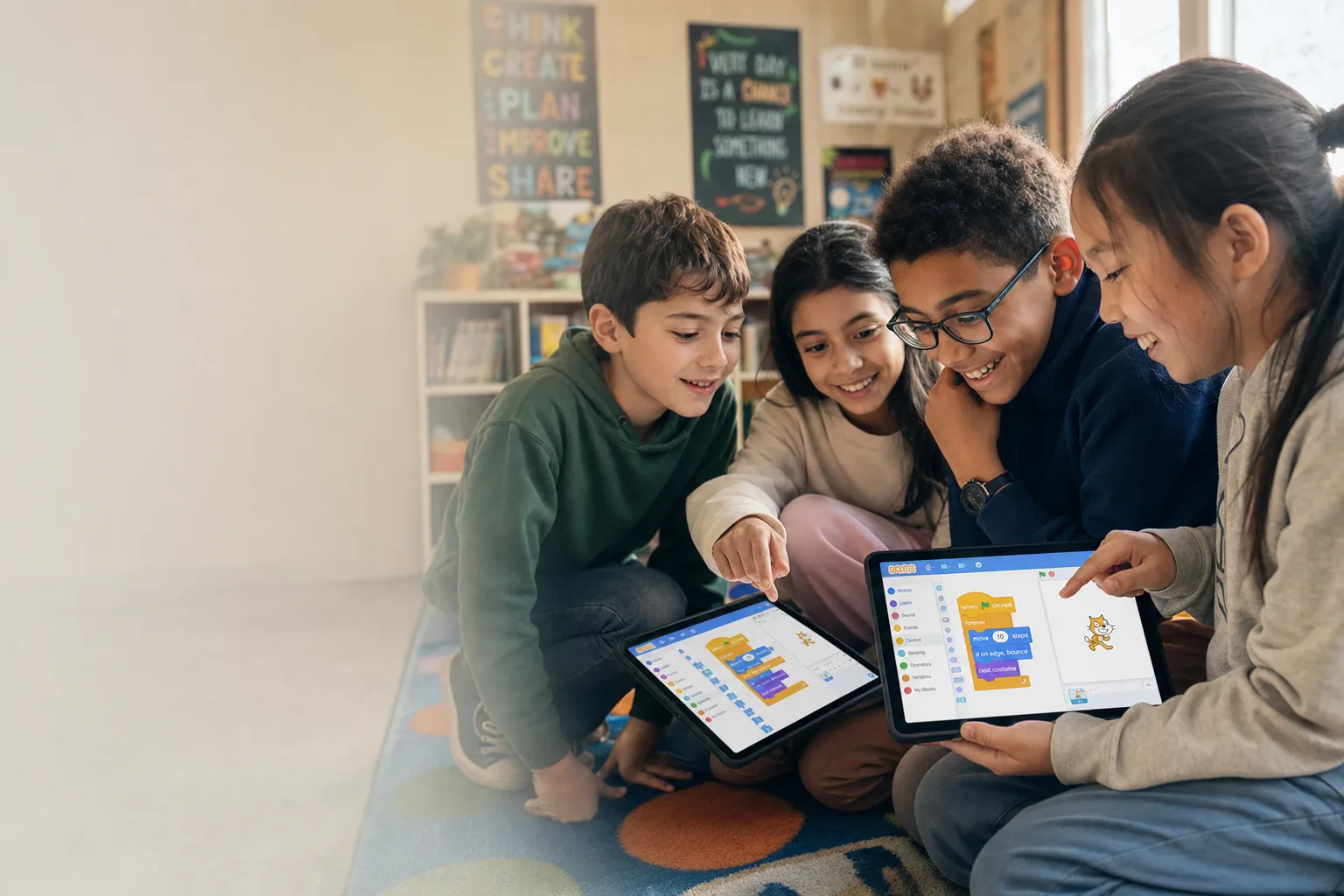
For students in grades 3-5, platforms like Scratch introduce block-based programming where students can build games, animations, and interactive stories. The logic becomes more complex, the feedback loop becomes more explicit, and the satisfaction of building something another person can actually use becomes real.
For middle school students, text-based languages and platforms like Microsoft MakeCode introduce the precision and patience that professional programming requires. The persistence developed at earlier stages becomes the foundation for engaging with genuinely hard technical problems.
Confidence Built Through Visible, Earned Achievement
A child who completes a coding project has something real to show for it. Not a participation ribbon. Not a rubric score. A working thing they built that did not exist before they sat down.
That is a specific kind of confidence. It is not the confidence that comes from being told you are talented. It is the confidence that comes from evidence, accumulated proof that hard things are solvable. It compounds. The student who fixed a difficult bug on Tuesday approaches the harder problem on Thursday differently. That shift is what parents notice first.
Coding as Preparation for a Technology-Shaped Future
Parents who enroll their children in coding classes today are often thinking ahead. They are aware that the professional world their child will enter is one where technology fluency, not just familiarity but real understanding of how digital systems work, will be a meaningful differentiator.

What coding teaches in this context is not a specific language or platform. Those change. What it teaches is a relationship with technology that is active rather than passive: an understanding that software is made by people, that it can be interrogated, modified, and built from scratch, and that the problems it presents are problems a prepared person can solve.
That orientation, technology as something you work with rather than something that just happens to you, is increasingly rare. A child who develops it in middle school brings something to every subsequent environment that their peers without it do not have.
What the Belt System Adds to the Learning Equation
One of the structural features that separates a character development program from a standard coding curriculum is the presence of a visible, individual progression framework. At LTCA, the belt system makes growth concrete rather than abstract.
Each belt level represents specific technical skills developed alongside specific character qualities. A student advancing from white to yellow belt has not just built something and moved on. They have demonstrated, to a coach and to themselves, that they can approach a genuinely hard technical problem with the persistence and focus the next level requires. That is not a grade. It is evidence.
For parents trying to understand whether their child is actually learning, the belt system provides a concrete answer. Not “they seem to be doing well” but “here is specifically what they can do now that they could not do three months ago, and here is what they are working toward.” That specificity matters for students as much as it matters for parents. A child who can see a clear path forward has a reason to keep going that a child with no visible progression does not.
For Liberty Families Asking This Question
Many of the parents asking what coding teaches their kids are coming from Liberty. They have made the drive down I-35 to visit our location at 248 NE Barry Road in Kansas City, and they are deciding whether the commute makes sense as a regular part of the week.
What Liberty families who have been enrolled for a semester consistently report is this: the question they came in with, will my child learn to code, becomes less interesting over time. The answer they did not expect, my child handles difficulty differently now, becomes the one they talk about.
The code is real. The technical skill is real. But the persistence, the teamwork, and the earned confidence are the outcomes that last beyond the program, and beyond the screen.