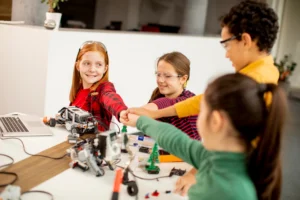

The programs parents keep talking about five years after their child aged out all share certain qualities. Not the qualities that appear most prominently in their marketing materials. The qualities that are harder to see from the outside: the ones that show up in how a student handles difficulty, how a coach responds to a student who is stuck, and what the program is actually optimizing for underneath the curriculum.
Here is a shorter and more specific list of what makes a kids coding program genuinely good.
1. Character Development Is Built In, Not Added On
The strongest predictor of a program’s long-term impact is whether character development is structural or decorative. A program that teaches coding and also mentions values on its website is not the same as a program where character development is woven into every session design, every coach interaction, and every advancement decision.
At LTCA, the character framework is not a supplement to the coding curriculum. It is the curriculum’s foundation. The technical skills and the character skills are developed together, tracked together, and both required for belt advancement. A student does not advance because they can write a loop. They advance because they can write a loop and demonstrate the commitment and persistence that real technical work requires.
When evaluating a program, ask directly: how does character development appear in the session structure? If the answer is a program-wide value statement rather than a specific session-level practice, that tells you where character development actually sits in the program’s priorities.
2. Instructors Understand Both Coding and Kids
Technical competence and teaching competence are different skills. A program staffed by excellent coders who have not been trained to work with children will produce a different result than one where instructors understand both. The best coding instructors for kids can hold a twelve-year-old’s attention through a difficult bug, read a six-year-old’s frustration before it becomes shutdown, and adjust their approach in real time based on what each student needs in that moment.
That combination is rare and worth asking about specifically. When you visit a program, watch the instructors more than the students. What happens when a student gets stuck? How does the instructor respond to a child who says “I can’t do this”? Those moments reveal more about instruction quality than any demo project or curriculum overview.

3. Individual Progress Is Tracked and Made Visible
A good after-school coding program does not move students through a curriculum in lockstep. Every child arrives with different prior experience, different cognitive development, and different emotional readiness. A program that advances all students at the same pace is either boring the fast learners, losing the slower ones, or both.
The belt system at LTCA solves this by making progress individual and visible. Each student advances at the pace their skill and character development actually supports, not faster to seem impressive, not slower than necessary. Parents can see exactly where their child is and what is required to move forward. That transparency is not just useful for parents. It is motivating for students. A child who can see a clear, specific path forward is a child who understands the work has a direction.
4. The Program Has a Clear Theory of What It Is Building
Good programs know what they are trying to produce, and they can say it plainly. Not “future-ready learners” or “21st-century skills.” Something specific and observable: students who handle hard problems without giving up. Students who can articulate what went wrong and try a different approach. Students who collaborate genuinely rather than dividing tasks and working in parallel.
LTCA’s theory is explicit: coding and robotics and esports are the tools, and integrity, persistence, teamwork, and commitment are the outcomes. That specificity means the program can be evaluated against it, and it holds up under evaluation, which is why families who leave because their child aged out often tell us they look for the same qualities in whatever comes next.
5. The Challenges Are Real, Not Curated for Success
A program where students never truly fail is a program that is not developing persistence. Real technical challenges produce real failures: code that will not compile, robots that do not behave as designed, logic that seemed correct and was not. A good program does not protect students from those failures. It structures the environment so students experience failure as information rather than verdict, and develop the capacity to keep working.
That distinction separates a genuine technical education from an engagement product. Engagement products are designed to keep students happy and coming back. Technical education is designed to produce growth, which sometimes requires discomfort. The best programs do both, but they never sacrifice one for the other.
6. The Program Can Tell You Specifically How Your Child Is Doing
The last quality on this list is practical and diagnostic: a good program can give you a specific answer to a specific question about your child. Not “they are doing great.” What specifically did they work on this week, where are they in the progression, and what is the concrete next challenge they are working toward?
If a program cannot answer that question specifically, it is not tracking individual students closely enough to produce individual outcomes. And producing individual outcomes: a specific child who is different in specific ways because of this specific program, that is the whole point.

Questions Worth Asking When You Visit a Program
The six qualities described in this post are most clearly visible during a session visit, not in a conversation with the front desk. When you walk into a program, here are the questions worth carrying with you.
Watch what happens when a student makes an error. Does the coach pause and let the student work through it, or does the coach immediately provide a correction? The pause is the signal. A coach who waits, who creates space for the student to think, is building problem-solving capacity. A coach who corrects immediately is building dependence.
Ask a student what they are working on. A student in a program with real individual tracking can answer that question specifically. Not “coding” or “robots,” but something like “I am trying to get my robot to stop exactly on the line, and I keep overshooting.” That specificity signals a student who is engaged with a real challenge and a program that has given them a real challenge to engage with.
Notice the atmosphere when something does not work. In a program where the culture is healthy, a failed test run or a buggy program is approached with curiosity, not distress. Students look at the result, say something about it, and try something different. That atmosphere is built by coaches over time and it tells you more about the program’s values than any curriculum document.
For Gladstone Families Choosing a Program
Gladstone families searching for a coding program for their child are a short drive from Love to Code Academy at 248 NE Barry Road in Kansas City. When you visit, bring this list. Ask the six questions. A program that answers them specifically and honestly is a program worth enrolling in.
LTCA has been serving Kansas City northland families long enough to be held to the standard this list describes. The program is built to hold up under exactly the kind of scrutiny a careful parent brings.