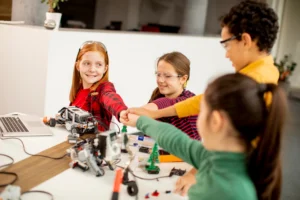

Most children who go on to love their coding program walked in uncertain. Some were resistant. Some were quietly convinced they would be bad at it and were already preparing to be embarrassed. The parent who brought them in had no way of knowing this at the time.
What parents say in the weeks before the first session shapes how the first session feels for the child. Not completely. But more than most parents realize.
The families whose children settle in quickly and start building the persistence habits that last years tend to have had a particular kind of conversation before day one. It is not complicated. But it is specific. And what most well-meaning parents say instead tends to work against them.
What Most Parents Say (And Why It Often Backfires)
The default conversation sounds something like this: “You are going to love it.” Or: “You are so good with technology, you will be great at this.” Or: “It will be fun, I promise.”
These are not wrong things to say. They come from a good place. But they set a standard the first session almost never meets, because the first session is genuinely hard for most children. It is new. There are other children who seem to already know what they are doing. The problems do not always work out. There is friction.
A child who walked in expecting to love it and be great at it walks out of a difficult first session with a specific conclusion: the parent was wrong, and this program is not for them. The expectation became the obstacle.
The families whose children stick through the first few sessions and discover what the program actually offers tend to have framed it differently from the start.

The Conversation That Actually Helps
The conversation that works does two things. First, it names the difficulty honestly. Second, it reframes what the difficulty means.
Something like: “It is going to be hard at first. Most things worth doing are. The point is not to be good at it right away. The point is to try it and see what happens.”
That framing does something specific. It removes the standard of immediate success. A child who walks in knowing it will be hard is not surprised when it is. They expected this. The difficulty is not evidence they do not belong. It is exactly what they were told to expect.
The second useful piece is giving the child something to watch for rather than something to feel. Instead of “you are going to love it,” try: “Watch for the first time something you try actually works. Notice what that feels like.” Now the child has a job. They are looking for a moment rather than waiting to feel a feeling. That is a much smaller, more achievable target for a first session.
What to Do If They Resist After the First Session
Resistance after the first session is extremely common and almost always worth sitting with rather than responding to immediately. The child who comes home and says “I didn’t like it” has usually had an experience that was harder than they expected. That is normal. That is the program working.
The useful response is not to defend the program or push back on their experience. It is to ask a specific question: “What was the hardest part?” Not “what didn’t you like.” What was hardest. That question validates the difficulty while directing attention toward it rather than away from it. A child who articulates what was hard is a child who is already starting to process it.
Programs that families stay in are almost always programs where parents held the first-session resistance gently and gave the program three to five sessions before drawing any conclusions. One hard session is not data. Five sessions where a child still comes home saying “I hate it” is worth a real conversation about fit.
Keeping the Conversation Going Once They Are Enrolled
The conversation does not end after the first session. It changes shape. A parent who asks “how was coding?” after every session is going to get the same one-word answer every time. The question is too broad to produce useful information.
Better questions: “What were you working on today?” “Was there anything you couldn’t figure out?” “What did you try when it didn’t work?” These questions tell the child that struggle is normal and interesting, not something to hide. They also give the parent actual information about what is happening inside the program, rather than a summary approval or disapproval.

Parents who describe their child’s enrollment as a genuine success are almost uniformly the ones who stayed curious about the process rather than the result. Not “are you getting better?” but “what are you working on?” Those are different questions, and they build different kinds of children.
What the Programs That Keep Students Have in Common
The programs parents and children stay with through difficulty share a specific quality. They make the difficulty feel like part of the design rather than evidence of a problem. The coach does not apologize when a session is hard. They name it: this is hard, and that is what this is for. The student does not feel like they failed. They feel like they are on track.
Parents who walk into an enrollment conversation looking for a program that will be easy are looking for the wrong thing. The program that will change their child is the one that will be genuinely challenging, and that will be structured to make the challenge productive rather than discouraging. That structure is what the after-school program at Love to Code Academy is built around. The coding is the vehicle. The challenge is the point.
What to Do the Week Before the First Session
The week before a first session is when parent anxiety and child uncertainty tend to peak simultaneously. The parent is hoping the enrollment decision was right. The child is imagining a room full of people who already know what to do.
The most useful thing a parent can do in that week is keep the conversation light and specific. Not “are you excited?” which requires the child to perform an emotion they may not feel. Instead: “What do you think you will try first?” That question is forward-looking and low-stakes. It puts the child in the role of someone who has a plan rather than someone waiting to be evaluated.
It also helps to make the logistics concrete without making them precious. Where the building is. What the session looks like in terms of time. Whether there will be other new students. Children who know what to expect logistically spend less cognitive energy on uncertainty and more on the actual experience. The unknown is what produces anxiety. Making the unknowns smaller is one of the most practical things a parent can do before day one.
For Liberty Families Getting Ready to Enroll
Families from Liberty enrolling at Love to Code Academy at 248 NE Barry Road are often in exactly this conversation with their child in the weeks before the first session. The child is uncertain. The parent is hoping for the best.
The most useful thing a parent can do in that window is set the right expectations: it will be hard, that is good, and the goal of the first session is just to try one thing. What happens after that tends to take care of itself.