
The search for an after-school coding program almost always starts with a map. Parents type in a location, see what is within a reasonable drive, and begin narrowing from there. That is a reasonable starting point. The problem is that proximity tells you nothing about quality, and the gap between a program that is close and a program that actually produces results can be significant enough to matter.
Parents make this decision well, and they make it poorly. The ones who make it well ask one question beyond proximity. The ones who make it poorly stop at the map.
What “Near Me” Gets Right
Proximity is not irrelevant. A program that requires a forty-five-minute drive each way four days a week is a program that competes with every other commitment in a family’s schedule, and in most cases, it loses within a semester. The practical sustainability of an enrollment matters. A child who attends consistently for two years in a program that is fifteen minutes away will almost always develop more than a child who attends sporadically in a program that is closer to perfect but farther away.
So the search that starts with proximity is starting in a reasonable place. The question is what to add to it.
The One Question to Add to the Search
The question that separates the parents who find what they are looking for from the ones who do not is: what does this program produce in a child, beyond technical skill?
A kids coding program that produces technically capable students is doing its job. But the programs parents keep talking about five years later produce something else alongside it: children who handle difficulty differently, who persist when they are stuck, who work with other people more honestly than they did before they enrolled. Those outcomes require a program with a deliberate framework for developing them, not just a curriculum for developing code.

That question, what does this program produce in a child beyond technical skill, will quickly separate the programs worth visiting from the ones that are simply nearby.
What to Look for in the Program Structure
When you visit a program, three structural features tell you more than any conversation with a salesperson. First: is there a visible progression system that tracks individual student development? A student who has been enrolled for eight weeks should be able to tell you exactly where they are and what the specific next challenge is. Second: do coaches track character development alongside technical skill, and does it affect student advancement? Third: what happens in the session when a student gets stuck? Does the coach wait, redirect, or provide the answer?
These structural features are either present or they are not. They do not require interpretation. You can observe them in a single session visit, which any program serious about what it is doing should welcome.
The Commitment a Real Program Requires
One of the things parents underestimate when searching for an after-school program is the commitment the right program will ask for, from the student and from the family. A program designed to produce real growth does not produce it in eight sessions. It produces it over a semester, then two, then a year. The families who see the outcomes they came in looking for are the ones who make the sustained commitment the program requires.
That is not a criticism of parents who try a program for a few weeks and then step back. It is a description of what the timeline actually looks like. If you are looking for a program where your child will visibly change, plan for at least a semester of consistent attendance before making a final evaluation.
Teamwork: What After-School Builds That Solo Programs Cannot
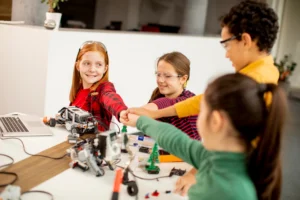
The after-school format builds something that self-paced online programs and solo tutoring cannot: teamwork developed under real conditions. A child who writes code alongside other students, who has to navigate a shared robotics build with someone who sees the problem differently, who competes and loses and wins in an esports session alongside peers: that child is building collaborative capacity in a way that does not happen in front of a screen alone.
This is one of the most underweighted advantages of a well-structured after-school program. The technical environment is shared, which means the character development is social. The patience, the communication, the ability to integrate another person’s perspective without losing your own: these develop in group settings, not solo ones.
What to Actually Evaluate When You Visit a Program
A program visit is most useful when you know what to watch rather than what to ask. Sales conversations are designed to reassure. Session observation tells you what the program actually does.

Watch the students, not the setup. What happens in the room when something does not go as expected? A student whose robot stops working, a student whose code throws an error, a student who finishes before the group: how the program handles those moments tells you what it is actually built to do. A program built around persistence lets students sit with problems. A program built around engagement resolves friction as quickly as possible. Those are different programs with different outcomes.
Ask one specific question of a student: what are you working on right now? The quality of the answer tells you whether the student has been given something real to care about. A student who can describe a specific challenge they are trying to solve is a student inside a program with real individual tracking. A student who describes an activity rather than a problem is inside a program that is managing time rather than developing people.
The Sustainable Enrollment Decision
The families who produce the best outcomes from a youth development program are not always the ones who chose the most impressive program. They are the ones who chose a good program and stayed consistently enrolled for long enough to see the results.
Proximity contributes to sustainability in a real way. A program that is fifteen minutes away and attended consistently over two years will produce more growth than a program that is thirty-five minutes away and attended sporadically over the same period. This is not an argument to settle for the closest option. It is an argument to factor sustainability into the decision from the beginning.
When evaluating programs near you, ask: will this family be able to attend twice a week for a full year without the logistics becoming a reason to stop? The program that passes that test and also passes the quality tests described above is the right program. Proximity in service of consistency is a real advantage.
For Smithville Families Searching Near Me
Families from Smithville searching for an after-school coding program are approximately twenty-five minutes from Love to Code Academy at 248 NE Barry Road in Kansas City. That drive puts LTCA on the edge of what most families consider “near me,” and it is a drive that Smithville families who have made it consistently tell us they do not regret.
The program at LTCA is built to produce specific outcomes: technical skill developed alongside persistence, teamwork, commitment, and integrity. Those outcomes are visible. They show up at home before they show up anywhere else. Smithville families who want to see what the program actually looks like are welcome to visit a session. That visit is almost always where the decision gets made.