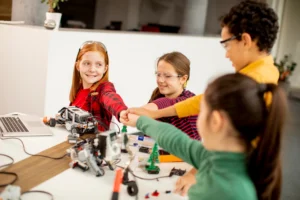

Parents searching for the right coding program encounter the phrase “character-based” with increasing frequency. It has become, to some degree, a marketing term, applied to programs that include a values statement in their welcome packet or a poster about teamwork in their classroom. That is not what a character-based program is.
The difference between a program that uses the term and one that is actually built around character development is visible in about twenty minutes of watching a session. Here is what to look for, and what parents should understand before they decide.
What a Regular Coding Class Delivers
A regular kids coding class is designed to teach programming concepts and produce students who can write code. The best versions of these programs are genuinely excellent at that goal. Students learn syntax, logic, debugging practices, and project-building skills that transfer into computer science coursework and eventually into professional capability.
The limitation is not that the program is bad. It is that the program optimizes for one outcome: technical skill. The other outcomes are either incidental or absent. A student who completes a strong technical coding curriculum will be able to code. Whether they are more persistent, more honest with themselves about failure, more capable of genuine collaboration: that depends on the student, not the program, because the program was not designed to develop those things.
That is not a criticism. It is a description. A regular coding class is a coding class, and it should be evaluated as one.
What a Character-Based Program Actually Requires
A genuine character-based coding program requires that the character development be structural, not supplemental. It is not enough to talk about integrity in a welcome session and then run a standard coding curriculum. The character framework has to appear in every session design, every coach interaction, and every advancement decision.
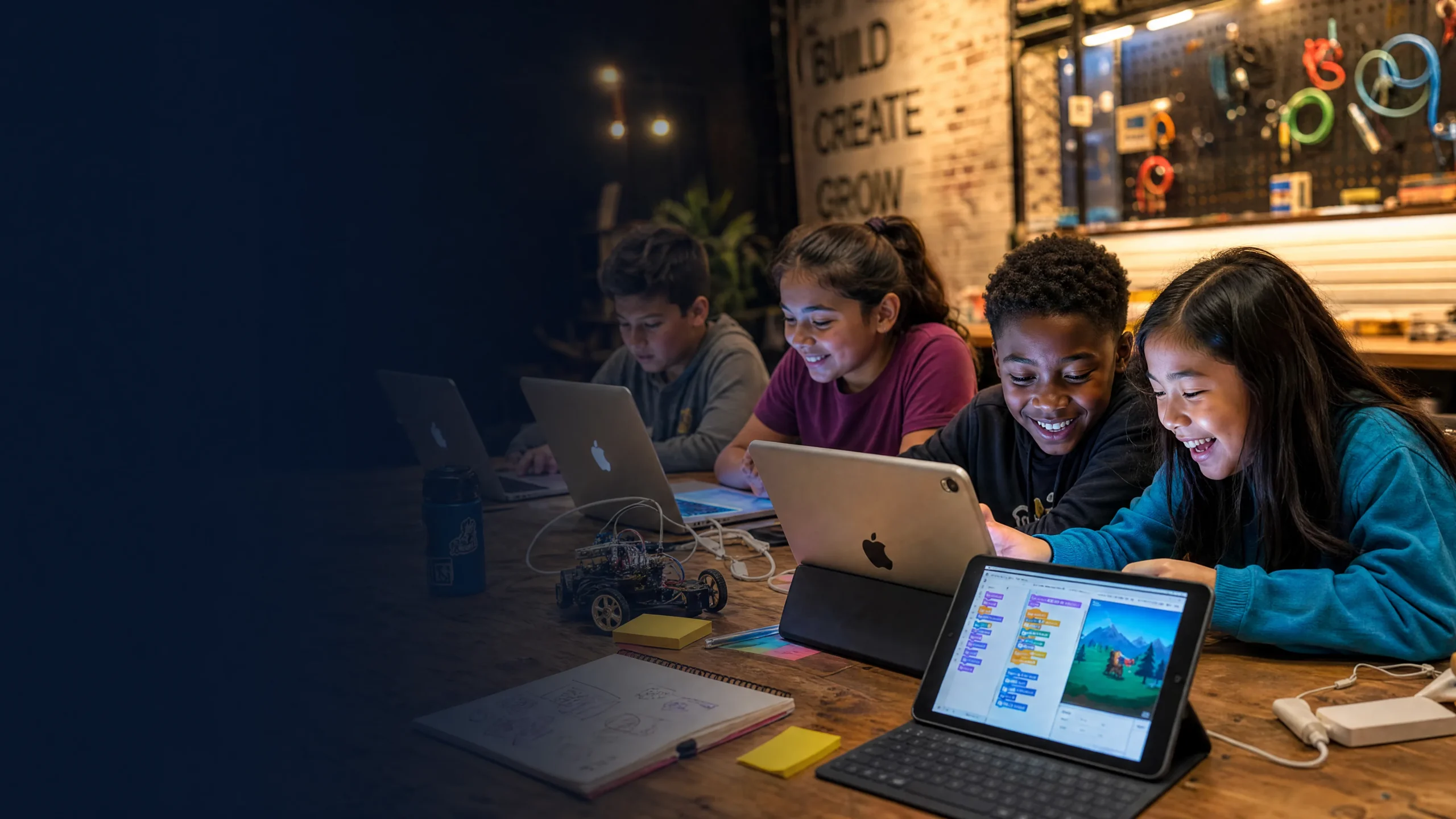
At LTCA, a student does not advance through the belt system by demonstrating technical skill alone. They advance by demonstrating both technical skill and the character qualities that belt level requires: persistence when the code is not working, commitment to seeing a project through, teamwork in collaborative builds, integrity in how they report their own progress and challenges. A coach who observes a student who writes clean code but gives up at the first error does not advance that student. The code is evidence of technical progress. The behavior is evidence of character progress. Both are required.
That integration is what makes the program character-based in a way that is more than a label.
The Difference You See Over Time (Marcus)
Here is the honest technical answer: a regular coding class and a character-based program will produce students with comparable technical skills in the short term. In the first year, the gap in coding ability between a student in a good technical program and a student at LTCA is minimal. They are both learning the same fundamentals.
The difference that opens up over time is not technical. It is behavioral. A student who has spent a year being explicitly coached on how to approach a problem they cannot immediately solve, how to read an error message without giving up, how to ask a teammate for input rather than plowing ahead alone: that student brings a different relationship to hard technical work than one who was taught only to write code.
In professional software development, the ability to stay in a difficult problem without catastrophizing, to debug systematically rather than randomly, to communicate clearly with a team under deadline pressure: these are not soft skills that happen to be nice to have. They are the difference between engineers who can work on hard problems and engineers who can only work on easy ones. Building them at eleven is not a character exercise layered on top of coding education. It is coding education done properly.
The persistence a student builds debugging a robot in seventh grade is the same persistence that keeps them from giving up on a hard feature at twenty-six. The program that builds it early, deliberately, structurally, at every session, is producing something a regular coding class is not designed to produce.
Questions to Ask Any Program Calling Itself Character-Based
If you are evaluating a program that uses this language, three questions will tell you whether it is structural or decorative.
First: does a student’s character development affect their advancement in the program? If the answer is no, if advancement is purely skill-based, the character component is supplemental. Second: how does a coach respond when a student gives up on a problem? If the answer is to provide the solution, the program is not building persistence. It is managing frustration. Third: can the program show you what character development looks like specifically in a session, not in a brochure? If the answer requires a brochure, look further.

The First Year: Where the Difference Actually Shows Up
In the first year of a well-structured character-based coding program, the differences that appear are not primarily technical. They are behavioral. Parents who have completed a year of enrollment at LTCA and are asked what changed describe a short list of consistent observations.
Their child handles frustration differently. The shutdown response, the “I can’t” response, the asking-for-help-before-trying response: these patterns become less frequent and less intense over the course of the first year. Not because the child was told to handle frustration better, but because they have spent fifty sessions practicing what it feels like to stay with a hard problem and come out the other side.
Their child talks about failure differently. A child in a program where failure is processed honestly and productively begins to report setbacks without shame. “My code didn’t work, so I tried changing the loop condition” is a different kind of sentence than “I couldn’t figure it out.” The first is a student who has internalized the problem-solving frame. The second is a student who has not yet learned to separate their identity from the result.
Their child collaborates differently. A year of working alongside peers on problems with real shared stakes builds the social and communicative skills that genuine collaboration requires. Students learn to speak precisely about technical problems, to listen to a teammate’s observation without dismissing it, and to hold their own perspective while integrating someone else’s. Those skills do not appear in a report card. But they show up in every classroom, every team, and every workplace the student will ever inhabit.
A regular coding class may produce some of these effects incidentally. A character-based program is designed to produce all of them deliberately.
For Riverside Families Deciding Between Programs
Families from Riverside who are comparing options, a standard after-school coding class versus a character-based program, are making a decision about what outcome they are purchasing. Both are valid choices. They are different choices.
If the goal is technical skill alone, a good standard program will deliver it. If the goal is a child who handles difficulty differently, in code and in every other part of their life, that requires a program where character development is structural. Love to Code Academy at 248 NE Barry Road is twelve minutes from Riverside. Come and watch a session. The difference is visible in twenty minutes.