
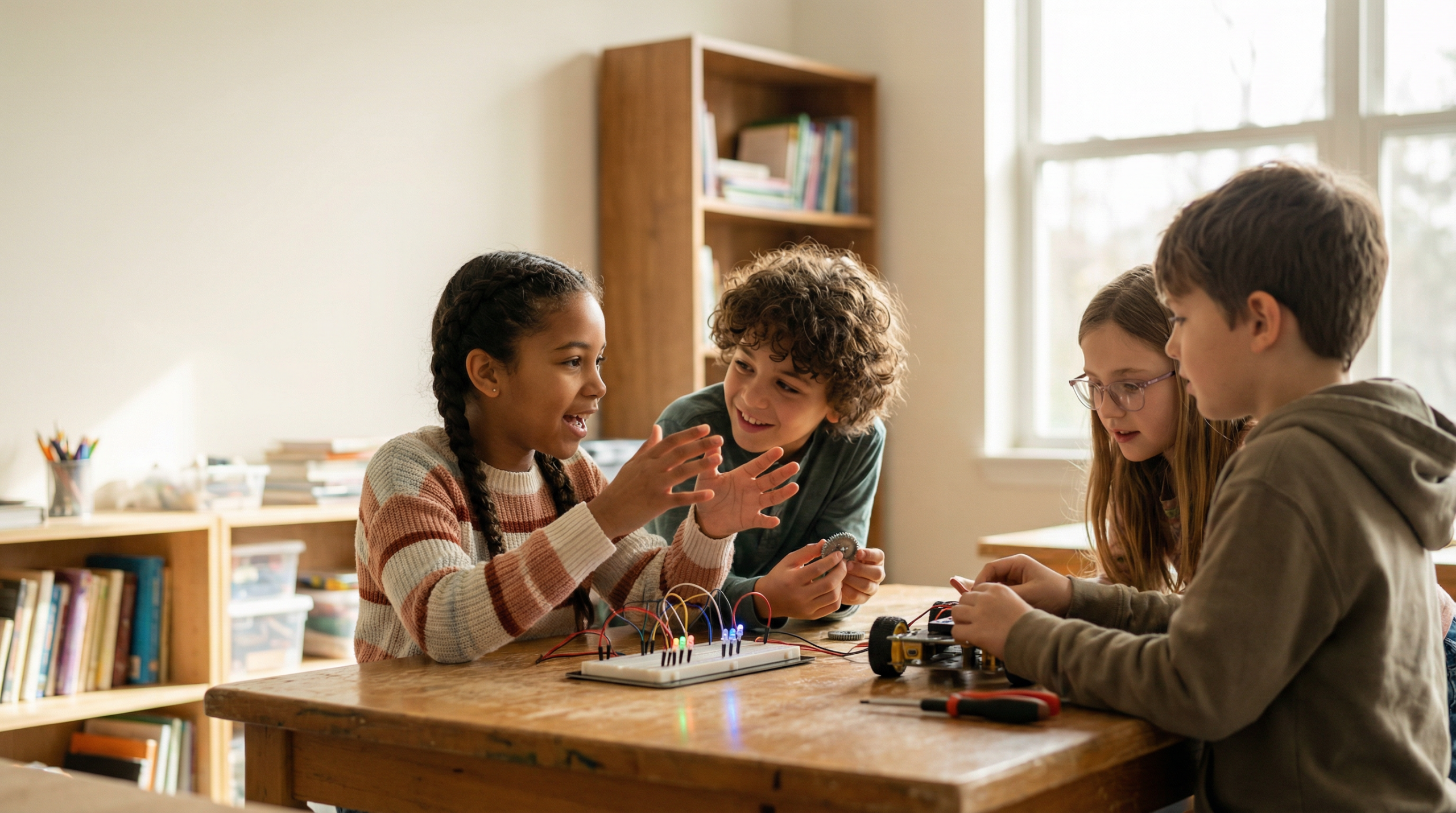
Your child goes to class every week. They seem to enjoy it, mostly. They come home, you ask how it went, you get “fine” and a quick summary of what they were building. You can see the project. You can tell they are engaged. But you have no real way of knowing whether the program is actually making a difference. Not in the “they built something cool” sense. In the “they are becoming a better person” sense.
This is one of the most common things parents feel but do not always say out loud. They chose this program because they hoped it would do something more than teach a skill. But they are not sure what they are looking for. They do not know what growth actually looks like from the outside.
Why Progress Is Hard to See From the Outside
Most programs offer visible proof of skill development. A finished project. A certificate. A presentation at the end of the term. These things tell you your child completed something. They do not tell you much about who your child is becoming.
Character development does not show up in a grade or a progress report. It shows up at the dinner table, in the car, in the moment your child faces something hard and you get to watch how they respond.
The question to be asking is not whether the program has a good curriculum. The question is whether it is changing how your child handles difficulty, setbacks, teamwork, and their own mistakes. And that question can only be answered by watching what happens outside the classroom.
The Four Behaviors to Watch For at Home
There are four specific behaviors that emerge when students are developing character through consistent coaching and real challenge. You can observe all of them at home. None of them require any knowledge of what is happening in the classroom.
The first is easy to miss because it sounds small. A student who used to say “I give up” or “I cannot do this” starts responding differently when they get stuck. Instead of shutting down, they stay in the problem a little longer. They say “let me try one more time” before asking for help. That shift, from walking away to persisting, is one of the earliest visible signs that real growth is happening. When it becomes a pattern rather than an occasional good day, something is genuinely being built.
The second behavior is more obvious once you are watching for it. Your child starts noticing when someone else is struggling and does something about it. A sibling. A teammate. A classmate who is stuck on something. Instead of staying focused entirely on their own work, they step in and offer support. That move from individual focus to genuine peer awareness is a meaningful marker. In the classroom, it shows up as a student who has stopped waiting to receive help and started offering it. At home, it looks like a kid who is actually paying attention to the people around them.
The third behavior is the one parents often describe as “catching themselves.” Your child makes a mistake and corrects it before you notice it. Before anyone points it out. Not because they were afraid of getting in trouble, but because they held themselves to a standard. This is one of the clearest early signs that integrity is forming: the student applies the same expectation to themselves whether or not anyone is watching. When this becomes consistent rather than occasional, it tells you something real is happening.
The fourth behavior is the one that tends to surprise parents most. Your child finishes something and then wants to make it better. Not because you suggested it. Not because it was assigned. Because their own standard was not satisfied by the first version. “I think I can make this better” or “I want to try a different approach” said without any external prompt. That internal drive to improve beyond what is required is one of the hardest things to teach and one of the most reliable signs of genuine development. When you start seeing it, pay attention.
How the belt system makes growth visible is one of the reasons LTCA can document these moments with precision. The four behaviors described above are not invented. They are the actual signals coaches observe across multiple sessions before a student advances to the next level. They appear in the classroom first. Then they begin showing up at home.
What to Do If You Are Not Seeing These Behaviors
If your child has been in a program for several months and you are not noticing any of these behaviors at home, it is worth asking about. Not as a criticism. As a straightforward question.
Ask the coach: what character traits have you been reinforcing this month? What have you noticed about how my child handles frustration when a project goes wrong? Has my child shown any leadership behavior in group work? A program built on character development should be able to answer those questions specifically, with observed examples rather than general reassurance.
If the answer is vague, that tells you something. Growth is not abstract. It shows up in moments you can see and hear. A program serious about developing character can name those moments because their coaches are watching for them every session. If that specific evidence does not exist, it is worth asking whether the system to produce it is actually in place.
Start with one honest question after each session: did anything happen today that your child handled differently than they would have three months ago? Growth is not abstract. It shows up in four specific behaviors you can observe at home, and a program serious about character development can tell you exactly when those behaviors first appeared.
Ready to see this in action?
At Love to Code Academy, every session is designed to build the traits that matter most. Students enter as curious beginners and grow into confident creators, resilient problem solvers, and emerging leaders.