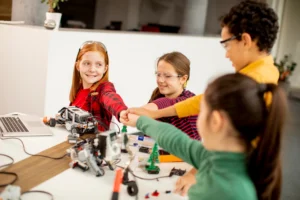

Parents choosing between a kids coding camp and an ongoing after-school program are making a real choice about format, not just logistics. The two are not interchangeable options for the same outcome. They produce different results by design, because their structures are fundamentally different.
Both formats work well for different children and different family situations. The parents who make the decision well are the ones who understand what they are actually choosing between.
What a Coding Camp Does Well
A summer or break-week coding camp delivers something specific: an intensive, immersive experience in a short window. For a child who has never encountered coding or robotics, a camp can provide a genuine first exposure that sparks interest, builds initial familiarity with tools and concepts, and creates a positive first association with the work.
Camps are also logistically simple. A defined start and end date, a predictable cost, and a contained commitment make them easy for families to plan around. They do not require semester-long scheduling adjustments.
For a child who is genuinely unsure whether coding or robotics interests them, a camp is a reasonable way to find out. The barrier is low, the exposure is real, and a week of hands-on work will tell a parent and a child more than any program description.
What a Coding Camp Cannot Do
A coding camp cannot build persistence. Persistence is not a concept that can be introduced in a week. It is a habit that develops through repeated exposure to difficulty over time: hitting a problem, trying again, failing differently, trying again. That cycle requires a semester, not five days.
Camps also cannot produce the character development that changes how a child handles difficulty outside the program. That transfer happens through accumulated repetitions in a structured environment. Five days provides exposure. Thirty sessions over four months produces change that shows up at home.

This is not a criticism of camps. It is a description of what their format makes possible and what it does not. A camp can introduce. It cannot transform.
What an After-School Program Does That a Camp Cannot
An ongoing after-school coding program builds the things that require time: depth of skill, consistency of habit, real peer relationships, and the kind of character development that transfers into a child’s broader life.
The belt system at LTCA is only possible in an ongoing format. Belt advancement requires demonstrated growth over multiple sessions: technical skill and character development both. That progression is visible, motivating, and cumulative in a way that a one-week experience cannot replicate. A student who has been enrolled for a year and advanced from white belt to orange belt has a visible record of real growth.
The commitment the ongoing program asks for, consistent attendance, sustained effort on multi-session projects, the responsibility of being part of a regular peer group, is itself part of the development. Showing up week after week, staying in a hard problem across multiple sessions, and seeing a long-term project through to completion are not incidental experiences. They are the curriculum.
The Right Tool for the Right Situation
For a child who has never tried coding and whose family is uncertain about the fit: a camp first, then enrollment in a semester program if the interest is confirmed. The camp answers the interest question. The ongoing program answers the development question.
For a child whose interest is already established and whose family is looking for real, sustained growth: skip the camp and enroll directly in an ongoing program. The camp’s introductory function is redundant, and the time spent on it is time not spent on the deeper work.
For a child who has done a camp and found it interesting but whose family is not ready for semester commitment: the interest is there, which is the most important thing. When the timing is right for the sustained commitment, the foundation the camp provided will still be useful.
The Question That Decides It
The question that most clearly separates a camp situation from an after-school program situation is this: are you looking for an experience, or are you looking for growth?
Experiences are valuable. A child who attends a coding camp and comes home talking about what they built has had a real and positive experience. But experiences and growth are different things, and a parent who wants the latter needs a format that is structured to produce it.

What a Camp Experience Typically Produces, and What It Does Not
The outcomes a well-run coding or robotics camp reliably produces are specific and worth naming. A child leaves a camp with a first exposure to technical thinking, a positive association with the tools and the environment, and at least one project they built themselves. Those are not trivial outcomes. A positive first experience with a challenging activity is valuable, because it makes the step into a more demanding ongoing program feel possible rather than daunting.
What a camp typically does not produce is lasting behavioral change. A child who was impatient with difficulty before the camp tends to still be impatient with difficulty after it. Five days of coding experience does not recalibrate the emotional response to frustration. That recalibration takes the kind of repetition that only an ongoing program provides.
Understanding this distinction prevents the frustration parents sometimes feel when a child returns from a camp excited and engaged but shows none of that change three weeks later in other areas of life. The camp did what camps do. It introduced. It did not transform. Transformation requires a different format and a longer timeline.
Using a Camp to Make a Better Enrollment Decision
One of the most practical uses of a coding or robotics camp is as a low-stakes test of genuine interest. Before committing to a semester or a full year of enrollment in an ongoing program, a camp answers the most important preliminary question: does this child actually want to do this?
A child who attends a camp and comes home talking about the projects, asking questions about how things work, and expressing interest in continuing: that child has answered the question. The interest is confirmed. The step into an ongoing program is now an informed investment rather than a hopeful guess.
A child who attends a camp and comes home neutral, or whose interest fades quickly, has also answered the question. That answer is equally valuable. It suggests the fit is not strong yet, which may mean the child needs more time, a different entry point, or simply different timing. The camp investment is not wasted. It provided real information.
The families who use camps most effectively treat them as research, not as the destination. The destination is a program that produces sustained growth. The camp just helps identify whether this particular child is ready to pursue that destination now.
For Parkville Families Making This Decision
Families from Parkville who are weighing camps against ongoing enrollment are in a good position. Parkville is approximately ten minutes from Love to Code Academy at 248 NE Barry Road, close enough that the logistics of a semester commitment are manageable for most families.
The kids coding program at LTCA is built for sustained growth, not introductory exposure. If your child has already had the introductory experience, whether through a camp or on their own, and you are ready to invest in the development that requires time, this is the format that produces it.