
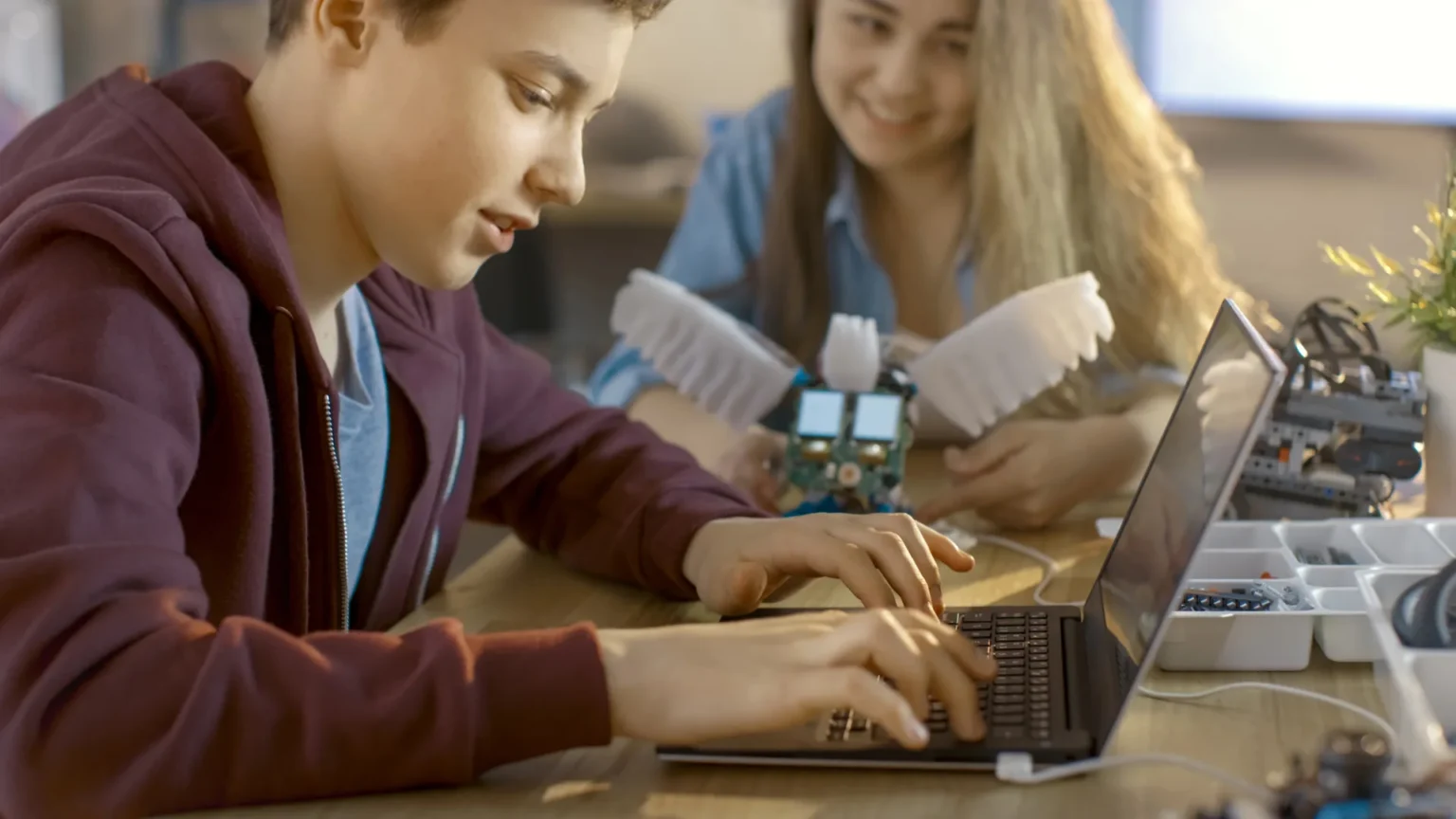
He came in for his first session wearing a jacket he did not take off for forty-five minutes. He sat near the door. He watched everything before he touched anything. The way children do when they are not sure yet whether a space is safe.
Three years later, he was the person the new kids watched. Not because anyone told them to. Because he was the one who knew where everything was, who knew how to ask the right question, who had a particular way of saying “what have you tried?” that made the newer students feel like the question was a real one, not a brush-off.
That arc, from the child near the door with the jacket still on to the student who carries the culture of the room, is what a character-based technology program is actually building. It is not the code. The code is the vehicle. The arc is the destination.
The White Belt: Where Every Student Starts
Every student at LTCA begins at white belt. Not because white belt is easy. Because white belt is the beginning, and the beginning looks different for every student.
A seven-year-old starting at white belt and a twelve-year-old starting at white belt are not having the same experience. The platform complexity, the challenge design, the session pace: all of these adjust to match the student’s actual developmental stage. What does not adjust is the starting point. Everyone starts at zero. Everyone earns their way forward.
What the white belt stage builds, before any technical skill is established, is the willingness to be a beginner in front of other people. For many students, that willingness is the hardest thing they will develop at LTCA. It requires tolerating not knowing. Tolerating trying and failing in a room where other people can see. That is the foundation everything else is built on, and it is what the white belt stage is designed to develop.
The Early Belt Levels: Building the Problem-Solving Frame
As students move through yellow and orange belt, the technical challenges increase. But what is actually developing beneath the technical skills is a frame: a way of approaching a problem that the student did not have at white belt.
The problem-solving frame looks like this. A student encounters something that does not work. They pause. They identify what specifically did not work. They form a hypothesis about why. They test it. They observe the result. They adjust.

That sequence is not intuitive at seven or eight. It becomes intuitive through repetition. A student who has run that sequence hundreds of times has internalized it. They are no longer following a procedure. They are being themselves.
The persistence that develops during this stage is the persistence of a person who has accumulated evidence that hard problems are solvable, not the persistence of someone who was told to persist. Those two things produce different behaviors under pressure.
The Middle Belts: When Students Begin to Teach Without Being Asked
Around the middle belt levels, something starts happening that is not written into the curriculum. Students begin helping each other.
Not because they were assigned to. Not because a coach prompted them. Because they see a younger or newer student stuck at something they remember being stuck at, and the most natural thing is to say something.
I noticed this first in a student who had been enrolled for about eighteen months. She walked past a newer student who was clearly frustrated, paused, and said “that error usually means the loop is off by one.” Not in a teaching voice. In the voice of someone sharing something useful. Then she kept walking.
That moment is not a small thing. It is a student who has internalized the culture of the room well enough to replicate it without prompting. It is mentorship beginning to form.
Lab Tech: The Student Becomes the Environment
The Lab Tech pathway at LTCA is the formal expression of what starts informally in the middle belts. A Lab Tech is a student who has advanced far enough technically and developed enough in character to take on a structured role in supporting the learning of others.
What makes the Lab Tech role meaningful is not the title. It is what it requires. A Lab Tech who is helping a beginner cannot just tell them the answer. They have to ask questions that help the beginner find the answer. They have to read frustration without absorbing it. They have to be patient in a specific way: the way of someone who genuinely wants the other person to figure it out.
That skill, the ability to support someone else’s learning, is one of the most transferable things a young person can develop. It appears in leadership, in teaching, in management, in parenting. A student who has practiced it at twelve carries a version of it into every subsequent environment.

What the Full Arc Means for Parents (Sandra)
The programs parents keep describing years after their child aged out are the ones where the child became someone in the process of attending. Not just more technically capable. Someone more patient, more willing to try hard things, more capable of helping other people through difficulty.
The arc from white belt beginner to Lab Tech is the visible shape of that transformation. It is not automatic and it does not happen in every program. It requires an environment where the character development is structural, tracked, and rewarded the same way technical skill is. At LTCA, the belt system makes both visible. The Lab Tech pathway makes the full arc complete.
How Long the Arc Takes
The arc from white belt to Lab Tech is not on a fixed timeline. Some students move through the early belt levels in eighteen months. Some take three years. The pace is not the point. What matters is that the arc is always pointing in the same direction and that every session is part of it, whether the student advances a belt or not.
What parents notice, when they have been enrolled long enough to see it, is that the arc does not feel like a linear march toward a credential. It feels like a child slowly becoming themselves in a particular way. More capable of difficulty. More willing to stay with what is hard. More interested in what the person next to them is building and whether they can help.
The Lab Tech designation is the formal recognition of something that was already true before the title arrived. It is confirmation, not transformation. The transformation happened across dozens of ordinary sessions, in small moments that nobody was marking as significant at the time.
For Kansas City Families Considering the Full Investment
Families across the Kansas City northland, whether from Parkville, Liberty, Gladstone, Riverside, or Smithville, who are asking what a long-term enrollment at Love to Code Academy actually produces are asking the right question. The full arc is the answer.
A child who starts at white belt and stays enrolled through the middle belts and into the Lab Tech pathway is a different person than the child who sat near the door with their jacket still on in the first session. Not different in a way that is hard to describe. Different in a way that shows up in how they handle difficulty, how they support the people around them, and what they understand themselves to be capable of.
The after-school program at 248 NE Barry Road is where that arc begins. The coding, the robotics, the esports: all of it is the vehicle. The arc is the destination.