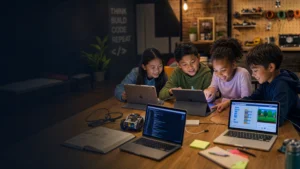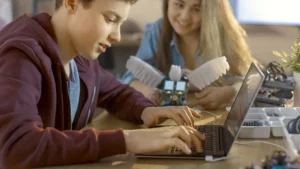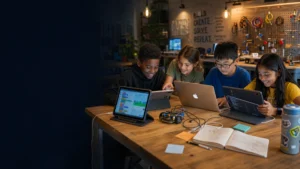
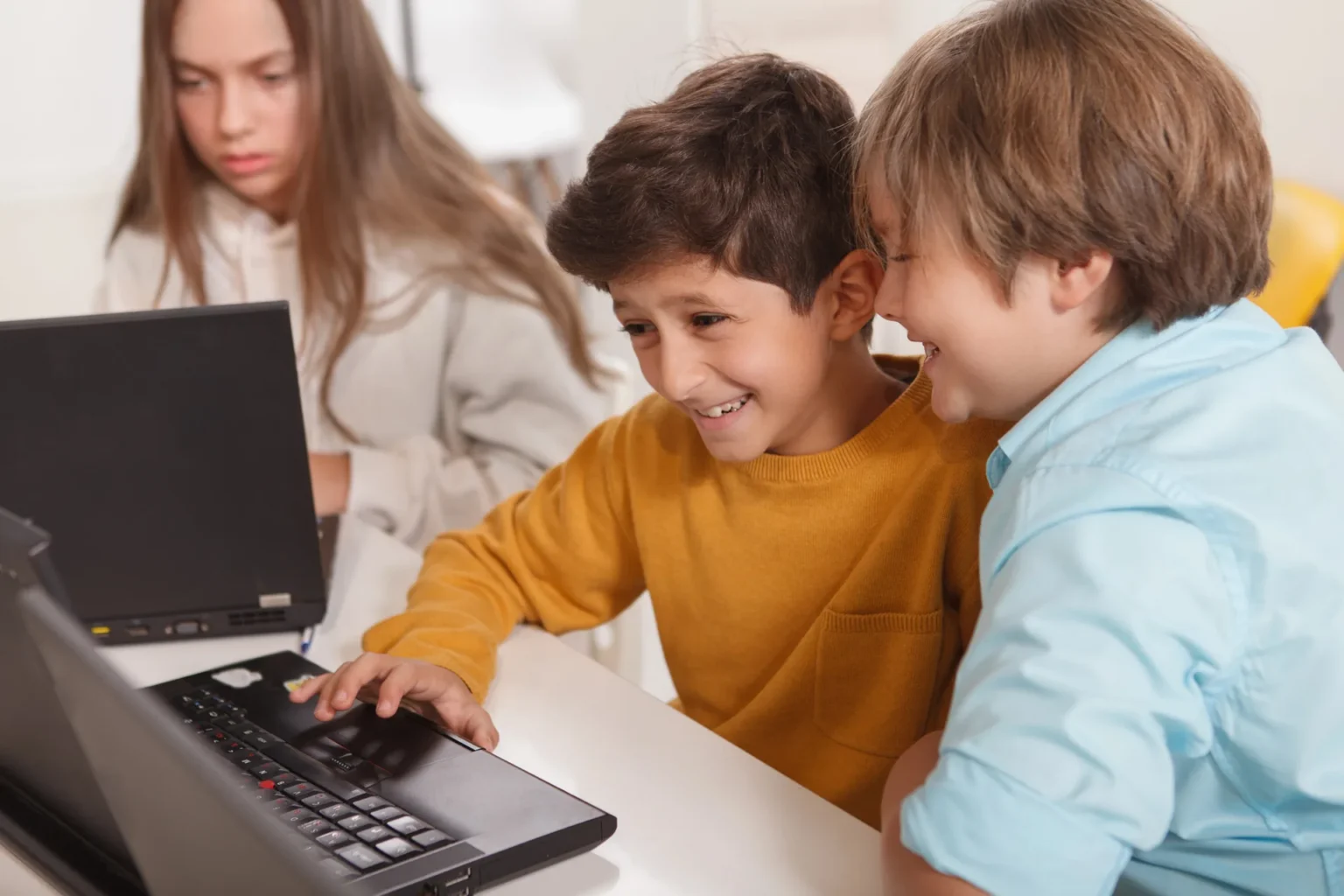
Two students were building together. They had been assigned the same robot. That was the whole of the structure. They had to share a screen, share a robot, and agree on what to try next.
For the first ten minutes, they worked past each other. Each one trying their own thing, not quite fighting, not quite collaborating either. The robot fell off the table twice.
At minute fourteen, one of them said, without looking up: “What if we try it your way first.” Not enthusiastically. Not because they had been asked to. Just because they had run out of their own ideas and were ready to try something else.
That moment is not in any curriculum. It is what happens when a program is structured well enough that real social friction has to be resolved rather than avoided.
Why Technology Programs Produce Social Development
A technology program is not an obvious place to look for social and emotional growth. It looks like children in front of screens. What is actually happening is more interesting than that.
The problems in a coding or robotics session are genuinely hard. They require more than one person’s thinking when they are done in groups. That necessity is the foundation of the social development. When the problem requires two people to solve it, and neither person can solve it alone, something social has to happen. Communication. Listening. Compromise. Trying something that was not your idea.
None of that is taught explicitly. It emerges because the problem demands it. That is a different kind of social development than what happens in a structured team-building exercise. It is functional, not performed.
What Self-Regulation Looks Like in This Context
A child who is frustrated because their code is not working and their partner wants to try something different is a child in a real emotional moment. The easy responses are to give up, to argue, or to take over. None of those work.
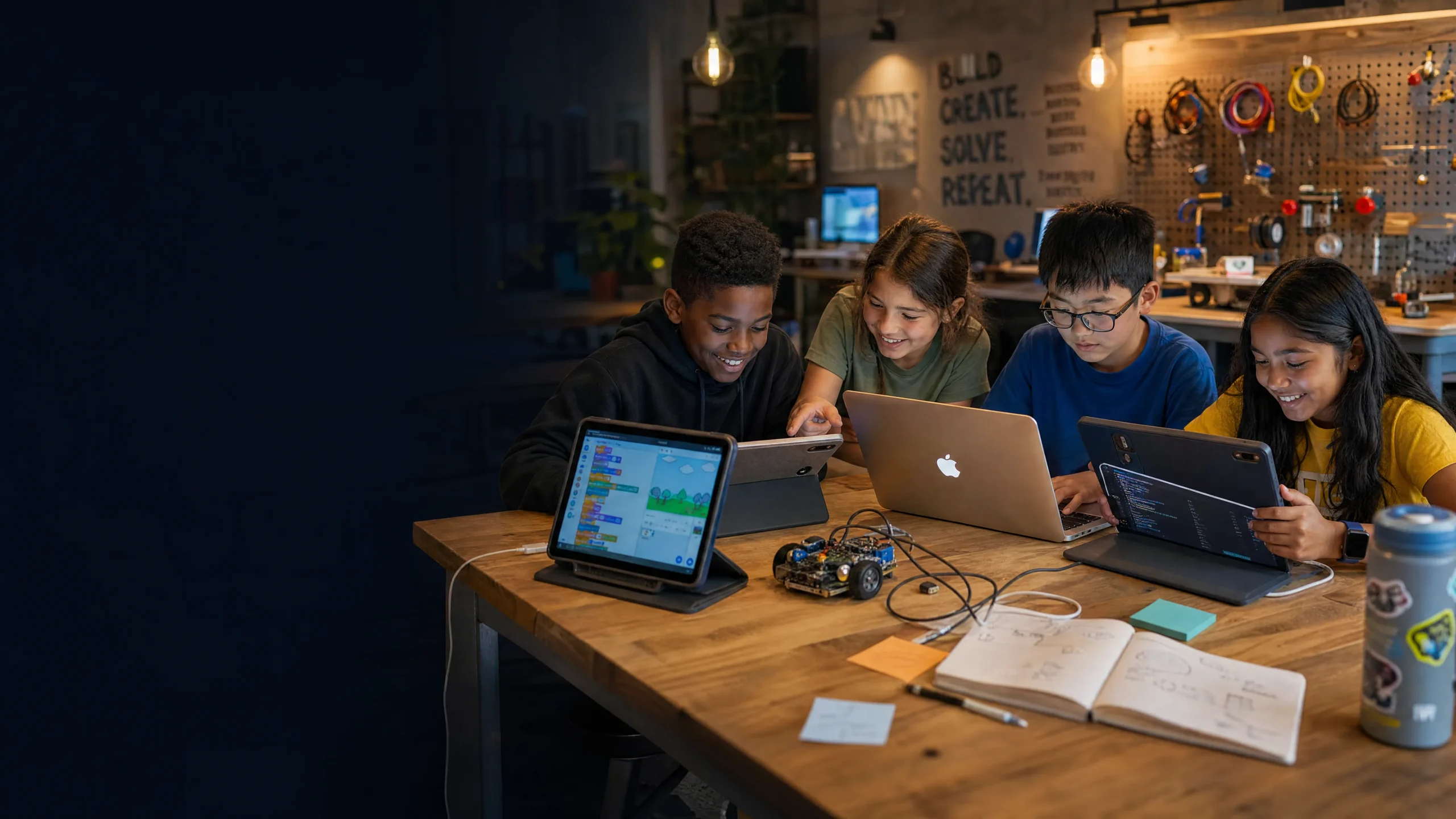
What the program builds, through repetition across sessions, is the capacity to stay in that moment without taking any of the easy exits. Self-control developed in a technology environment is self-control practiced under real stakes, not simulated ones.
I noticed a student once, about four months in, catch herself in the middle of a frustrated response and stop. Just stop. She looked at the screen for a moment. Then she said, to her partner: “What part did you think was wrong?” That pause, and that question, was months of session work becoming visible. She had not been taught to do that. She had practiced it, in smaller ways, dozens of times before that moment.
The Confidence That Forms in This Environment
Harmony in a technology program does not look like everyone getting along easily. It looks like students who have learned to work through disagreement without either giving in or shutting down. That is a harder skill and a more useful one.
The confidence that develops alongside the social growth is specific in character. It is not the confidence of being the best at something. It is the confidence of having navigated something hard with other people and arrived at a result neither of you could have reached alone. That confidence is more transferable than individual achievement confidence, because it does not depend on being the most skilled person in the room.
Students who develop it describe feeling at home in group settings in a way they did not before. Not because they are more extroverted. Because they know what to do when things get complicated, and they have done it before.
What Emotional Growth Looks Like at Different Stages
In K-2, the emotional growth is mostly about comfort with being a beginner. The child who can sit in a room full of other children and try something without knowing if it will work has done something real. That is the starting point for everything else.
In grades 3-5, the emotional growth centers on conflict navigation and shared accountability. Projects are more complex, teamwork is more required, and the friction of collaboration is more real. The students who learn to navigate that friction in this range carry the skill into middle school peer dynamics, where the stakes feel higher and the skill matters more.
In middle school, the emotional growth takes on a dimension that is closer to identity. A student who has been in a character-based technology program for several years has a specific self-concept: they are someone who figures things out. That self-concept is not fragile the way achievement-based self-concept is. It is grounded in evidence, not comparison.
The Connection Between Technical Progress and Social Development
The social and emotional growth in a technology program is not separate from the technical development. It runs alongside it, and the two reinforce each other in ways that are not always obvious from the outside.
A student who is genuinely challenged technically, who is working on problems that do not resolve quickly, is a student who is also practicing self-regulation under real pressure. The emotional work required to stay with a difficult problem is the same emotional work required to navigate conflict with a teammate, to try something in front of a group and not immediately succeed, to accept feedback and adjust without shutting down.
Because the technical challenges are real, the emotional and social challenges that arise in working through them are also real. A well-designed program does not separate “coding” from “character.” The character development is what happens in the space created by genuinely hard technical work. The hardness is not incidental. It is the mechanism.
What Parents Typically Notice First at Home
The social and emotional growth signals that parents observe at home are usually more surprising than the technical ones. Parents expect their child to learn coding. They do not always expect to see their child respond differently to conflict at dinner or handle frustration at sports practice differently than they did before enrollment.
The most consistent home signal in the first year is emotional patience: the interval between frustration and action lengthens. A child who used to escalate quickly in difficult social situations begins to pause. Not because they were taught a calming technique. Because they have rehearsed a different response, in a different context, dozens of times. The pause that appeared first in a coding session when a loop would not run correctly begins appearing in other contexts where things are not going as planned.
This is the transfer effect that parents mention most when describing what the program actually changed in their child. The social situation where they noticed it has nothing to do with technology. The response pattern was built inside a technology environment, and it transferred because character development does not stay contained to the context where it was built.
For Smithville Families Thinking About This
Families from Smithville who are evaluating youth programs and asking about social and emotional development are asking exactly the right question. The social and emotional skills developed in a well-structured technology program are not incidental to the technical curriculum. They are the reason the program is worth the drive.
Love to Code Academy at 248 NE Barry Road is about twenty-five minutes from Smithville. The after-school program is built around the structural conditions that produce real social development: problems that require genuine collaboration, a coaching culture that asks students to stay in hard moments rather than escape them, and a progression framework that makes character growth as visible as technical skill.