Why Early Coding is Truly About Character and Human Connection
A few years back, a father carried his three-year-old into our lobby and asked a simple question. Could we help his son build something instead of just tapping and swiping. That afternoon reshaped how we think about young learners. Screens should never be babysitters. Used well, technology becomes a tool that pulls kids toward people, ideas, and their own growing confidence. When we teach coding for toddlers, we are not preparing three-year-olds for software careers. We are using simple order and logic to grow steady focus, calm under frustration, and a quiet belief that they can figure things out.
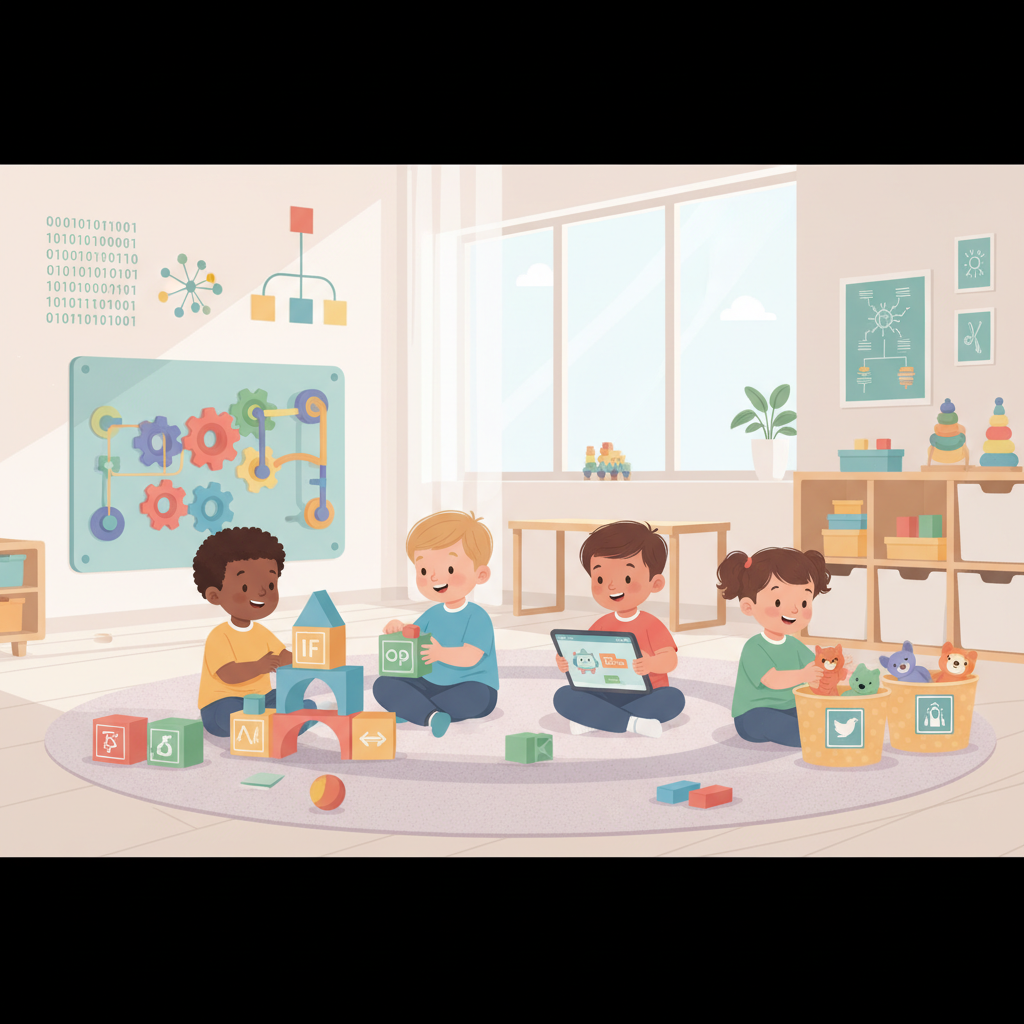
Toddlers feel everything at full volume. When a block tower topples or a pattern falls apart, the frustration is real and loud. This is the earliest stage of growth, and our goal is simple. We want little ones to feel safe enough to stumble, shake it off, and try one more time. Treat computational thinking as a shared game rather than a solo screen, and something shifts. Children start talking through their ideas and working side by side with a parent or a friend. That builds a durable kind of grit, the sort that shows up on the playground, in preschool, and long after. We grow kids, not just coders. And it starts with one playful puzzle.
How Everyday Routines Teach Toddlers the Logic of Code
Computational thinking sounds like a mouthful. At heart it is just an orderly way to break a task down and solve it. No expensive gadgets required, and no screens either. Parents can teach it through the ordinary rhythms of the day. An algorithm is really just a recipe, a set of steps that gets a job done, whether that job is brushing teeth, getting dressed, or making a sandwich.
To show a preschooler how it works, sketch out their morning as a little chart. Keep the drawings simple. Step one, socks. Step two, shoes. Step three, tie the laces. If your child reaches for the laces before the socks go on, the whole plan falls apart. It is a harmless, hands-on hiccup, and it teaches the golden rule of order. That gentle mistake shows them how real logic behaves and where responsibility fits in. In these small moments, children practice self-control and take ownership of the steps, and those are the pillars of the person they are becoming.
The Power of Screen-Free Coding Toys
Screen time worries nearly every parent, and yet no one wants their child left behind in a digital world. Screen-free toys close that gap nicely. They turn invisible computer logic into solid, physical objects. A toddler can hold, slide, and stack an idea. The learning becomes something they can feel, remember, and enjoy.
Take the Cubetto toy. It is a friendly wooden robot steered by a chunky control board. Children slot bright colored blocks into the board and send the robot rolling across a fabric map. Green means go forward, red means turn. By lining up those blocks, tiny hands write their very first programs, no screens anywhere in sight. Every choice they make produces a clear, predictable result, and that loop builds confidence along with a real sense of space and movement.
Simple, Active Games to Teach Coding at Home
You do not need to spend a dime on fancy gear. Some of the best games call for nothing more than chalk, a few household items, or a roll of masking tape. Floor grids are a favorite. They get kids up and moving while teaching direction, space, and teamwork.
Tape a big grid onto your living room floor, four squares by four. Set a stuffed bear in one corner and a plastic apple in another. Then hand out the roles. Your child is the programmer, and you are the robot. Their job is to guide you with clear spoken commands, something like step forward, turn right, step forward. This little game flips the usual family order upside down. It puts your toddler in the lead and shows them why precise words matter.
If they give the wrong instruction, follow it exactly. If Mia tells you to walk forward and the sofa is right there, bump gently into the sofa. That silly mishap teaches debugging in a way she will never forget. It also fills the room with giggles and teamwork, and it nudges her toward empathy, because now she has to steer her parent safely around the furniture.
Building Grit Through Tiny Coding Failures
Learning to program is one small failure after another, which makes it wonderful training for emotional grit. Picture a toddler laying out a row of path cards for a toy. The toy jams under the dining chair, and the frustration flares. Our job as guides is not to swoop in and fix it. It is to offer warm, open-ended clues instead.
Rather than doing the work for them, point to the floor and ask them to show you where the toy went off track. That one question changes everything. They stop feeling like they failed and start seeing a puzzle worth solving. It works a lot like the practice mat, where you repeat a movement until it feels natural. When coding is taught as a lesson in character, kids walk into school trusting their own ability to work a problem through.
A Simple Guide for Starting at Home
To put these ideas to work, build a small weekly rhythm. Fifteen minutes on a Saturday morning can shift how your child thinks and how they handle a tough moment. Aim for steady practice and a warm connection, not complexity.
Pick a corner of the rug and call it your logic lab. Begin with simple pattern games. Lay out colored blocks in a blue, red, blue, red sequence and ask your child to copy it. That is a loop, one of the first ideas in real code. Once patterns feel easy, move to the grid game on the floor. Keep every session short. Stop while they are still laughing and wanting more. That way they tie logic to joy and come back eager for the next round.
Key Lessons to Remember
- Start screen-free so your child builds real understanding before a tablet ever enters the picture.
- Turn daily habits like brushing teeth or baking cookies into lessons in step-by-step logic.
- Let your child fix mistakes with their own hands, so an error becomes a fun puzzle instead of a failure.
- Prize grit and clear speech far above getting the code perfect.
- Remember that technology is only the setting, and strong character is the real goal.
With a few simple habits like these, we help our children meet a digital world with confidence and a clear sense of purpose. The real mission was never the code. It is raising strong, capable kids.