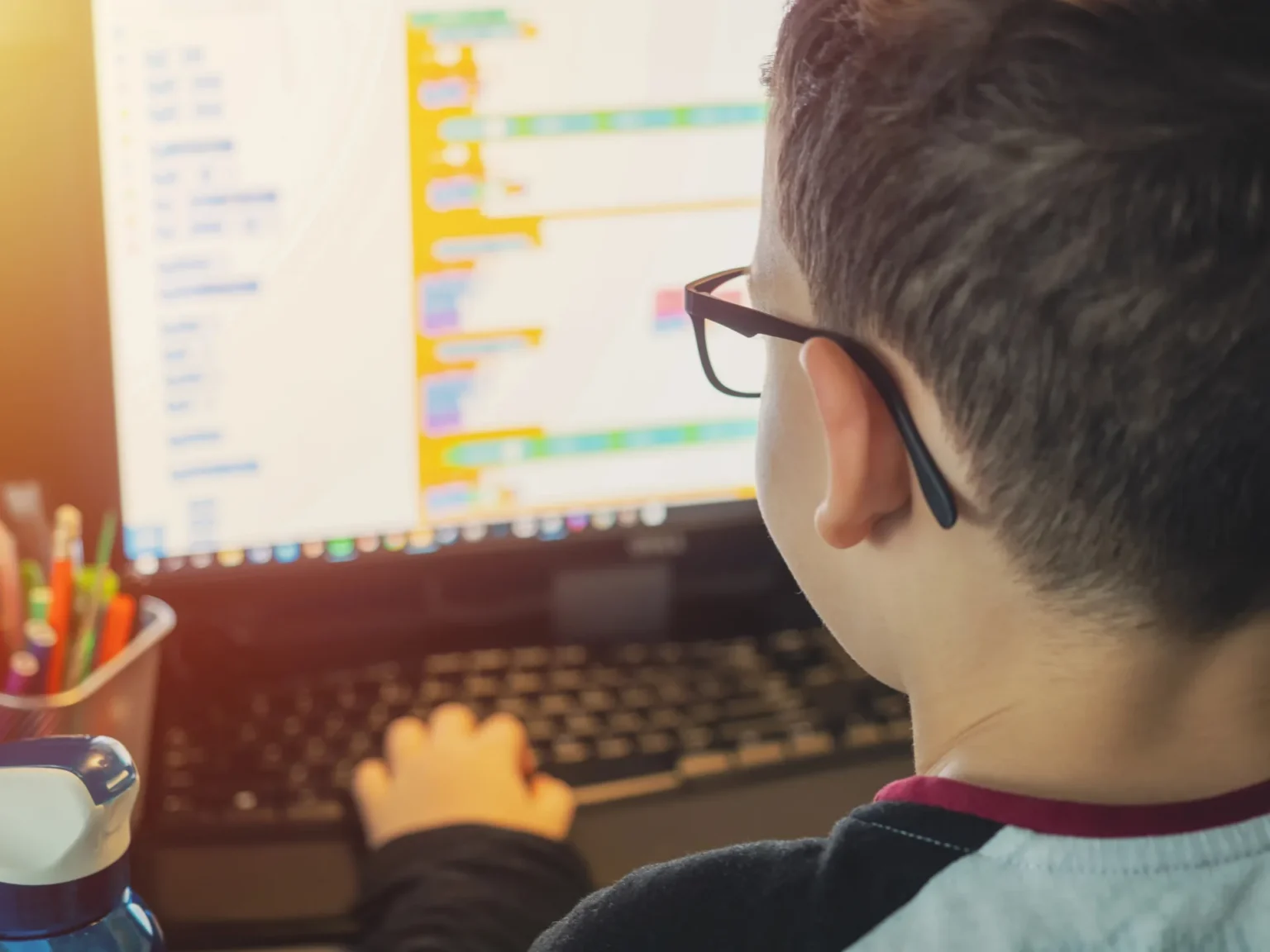
Parents sometimes assume Scratch is where you start before you do real coding. That assumption is understandable and wrong.
Scratch is a visual, block-based programming environment developed at MIT. It uses the same logical constructs as text-based languages: sequences, conditionals, loops, variables, events. What it removes is the syntax barrier. A student using Scratch is thinking like a programmer. They are just not typing angle brackets while they do it.
At LTCA, Scratch is the primary platform for beginning students in the early belt levels. Not because it is easy. Because it puts the thinking front and center and removes the obstacles that have nothing to do with thinking.
What Scratch Actually Is (And What It Is Not)
Scratch is not training wheels. It is a full programming language with blocks as its syntax. A Scratch project can contain nested conditionals, multi-threaded event loops, dynamic variable handling, and real-time physics simulation. A student who has reached the upper end of Scratch capability is writing logic that a professional programmer would recognize immediately.
What Scratch is not is text-based. That distinction matters for one reason: a student who hits an error in a text-based language spends cognitive energy on syntax. Where is the semicolon. Why is the bracket closed in the wrong place. That cognitive load is real, and for a student who is still building the logical thinking foundation, it is often the thing that makes the experience feel impossible rather than hard.
Scratch moves that obstacle out of the way. The student who cannot find their error is not hunting for a missing quotation mark. They are examining their own logic. That is the right problem to be solving at the beginning. Syntax can come later. Logic is the foundation.
What the Challenges Look Like at White and Yellow Belt
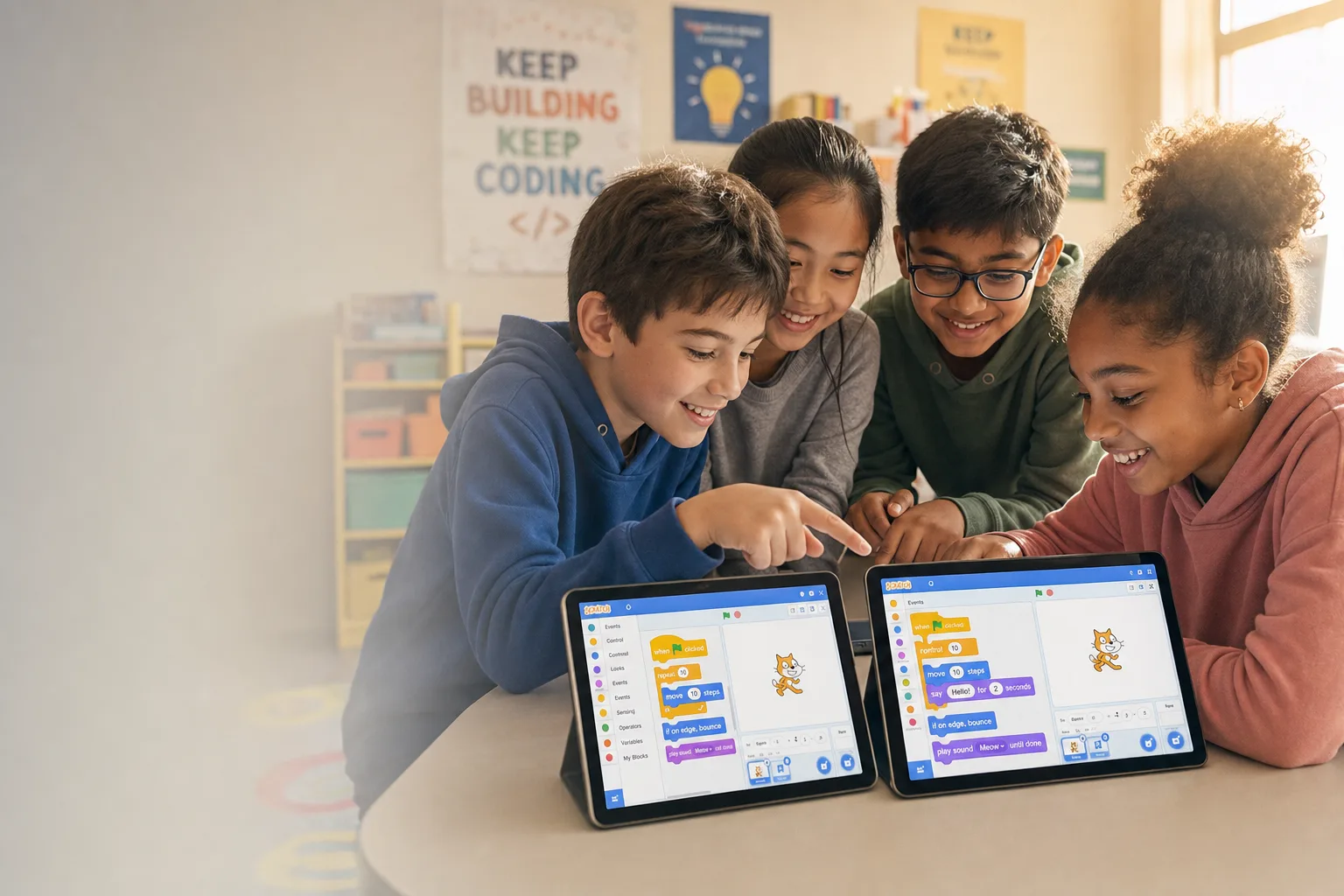
A white belt student using Scratch at LTCA begins with cause-and-effect fundamentals: if this block runs, what happens next? The problems are genuinely challenging for a beginner because the thinking required, holding a sequence of steps in mind and predicting what the program will do, is not intuitive for most children who have never written code.
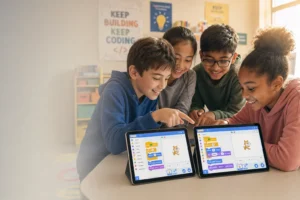
By yellow belt, students are working with conditional logic and simple event-driven sequences. A project that responds differently depending on user input. A character that changes behavior when a variable passes a threshold. These are real programming concepts. The student building them in Scratch is not doing simplified programming. They are doing actual programming in a visual environment.
The projects that emerge from this range, simple games, interactive animations, branching stories, are not demonstrations of technical trivia. They are evidence of a student who can decompose a problem, build toward a solution in steps, and debug their own logic when it does not produce the expected result.
The Thinking That Forms Behind the Blocks (Jordan)
Before a student can build anything in Scratch that works, three things have to be true. They have to understand what they want the program to do. They have to be able to break that goal into discrete steps. And they have to be able to predict what will happen when those steps run in sequence.
That is the engineering mindset in its simplest form: define the outcome, design the process, test the result. Scratch teaches this not through instruction but through experience. A student who builds a game that does not behave the way they intended has to ask: what did I expect, and what actually happened? The gap between those two things is the design problem. Solving it requires systematic thinking, not guessing.
The students who move most quickly through the early belt levels are almost never the ones who have used technology the most. They are the ones who have learned to articulate their own logic before they build. What are you trying to make? What do you think will go wrong? Those questions, asked before every build, are what make the Scratch environment a genuine engineering practice rather than a play activity.
What a Scratch Project Looks Like at the End of the Year
A student who has spent a full year working in Scratch at LTCA has a project portfolio that is genuinely worth showing. Not because the visuals are impressive, though they often are. Because the logic structures inside the projects are evidence of a specific kind of thinking that a parent, looking at the screen, might not even realize is there.
The projects contain loop structures, conditional branching, event-driven responses, and variable-based state management. Translated out of the technical language: these are projects where things happen for reasons, where the program makes decisions, where the student has built a system rather than a sequence.

That system-thinking capacity is what transfers when a student moves from Scratch into text-based languages. The syntax is new. The thinking is the same. A student who learned to think in Scratch has the foundation for everything harder. That is what Scratch is for.
How Scratch Prepares Students for Text-Based Languages
The transition from Scratch to text-based languages is a transition in syntax, not in thinking. A student who has spent a year building logical structures in Scratch already understands conditionals, loops, variables, and event-driven responses. What they do not yet know is how to write those structures in Python or JavaScript or any other text-based language.
Learning the syntax of a new language when you already understand the underlying logic is a manageable challenge. Learning the underlying logic and a new syntax simultaneously is the thing that makes text-based programming feel inaccessible to many beginning students.
Scratch removes the simultaneous burden. By the time a student moves into text-based work at LTCA, they are solving a vocabulary problem, not a thinking problem. The concepts are already in place. They just need new words for them. That transition is faster, more confident, and more durable than the transition made by a student who learned syntax and logic at the same time in a text-based environment from day one.
What Students Say About Scratch After They Have Moved Past It
Students who have advanced past Scratch into text-based coding at LTCA often describe the Scratch phase in retrospect as the period where the way they think about problems changed. Not the period where they learned to code. The period where they started thinking like someone who codes.
That distinction is meaningful. Technical skills can be learned at any stage. The thinking orientation that makes technical skills useful, the tendency to break a problem into components, test each component, and rebuild based on results, forms earlier and more durably in the right environment. Scratch, when it is used as a genuine logical thinking environment rather than a simplified coding toy, is that environment for beginning students.
For Smithville Families Asking About the Curriculum
Families from Smithville who are asking what their child will actually be doing in sessions at Love to Code Academy at 248 NE Barry Road often start by asking about the platforms. Scratch is the honest answer for beginning students.
What the platform teaches is logical thinking, cause-and-effect sequencing, and the problem-solving habits that underpin every technical skill that comes after. The coding program at LTCA uses Scratch not as a starting point to move past quickly, but as the environment where the real foundation gets built. The after-school sessions are where that foundation becomes something durable.